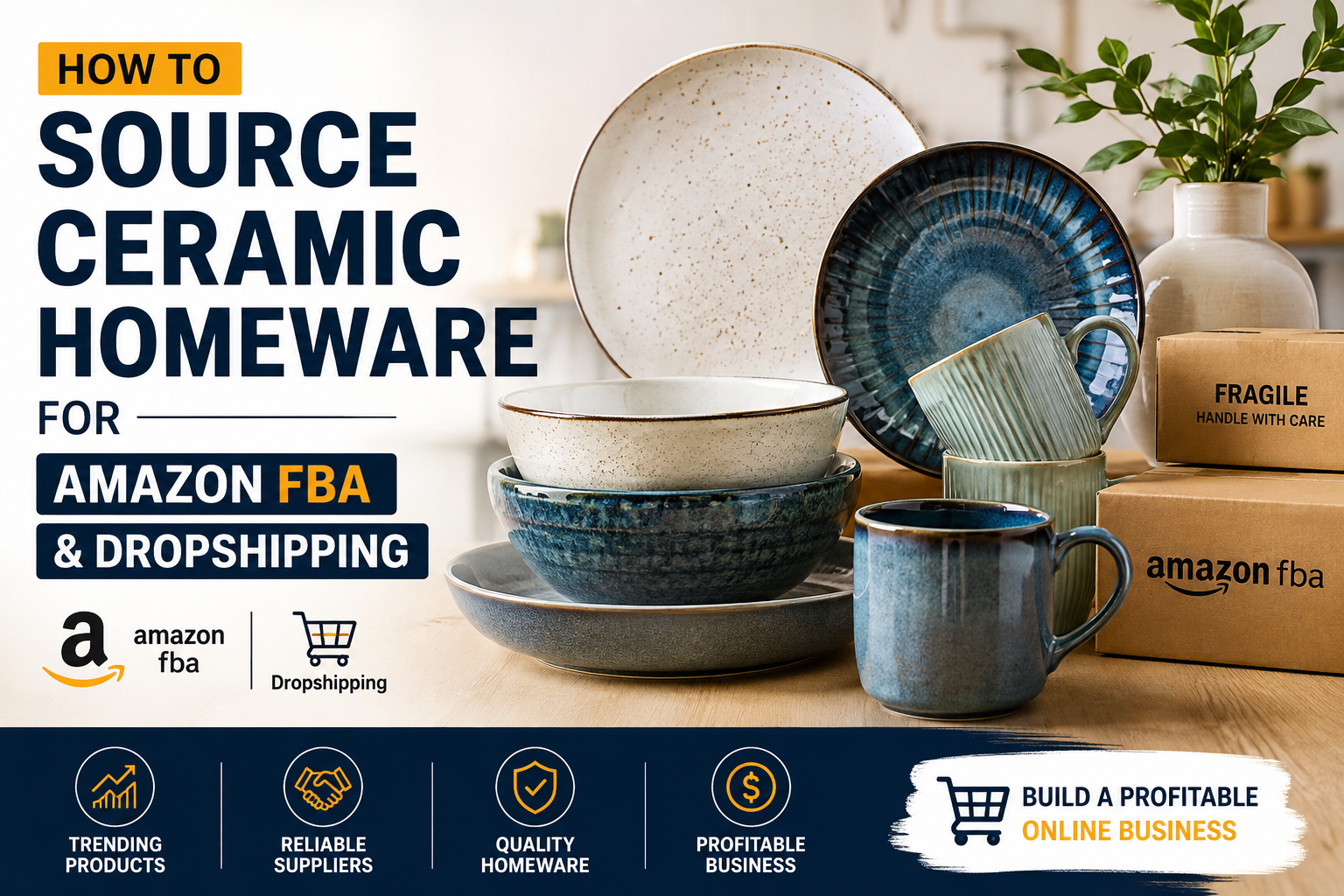
Ceramic homeware is a strong category for home and gift retailers. Glaze, shape, and surface detail give these products a tactile quality that customers can see and feel. Mugs, tea sets, incense holders, and decorative ceramics are useful in daily life, but they are also products people are happy to receive as gifts. This gives retailers more flexibility in pricing and leaves room for a reasonable margin.
For ecommerce sellers, the first order should be small enough to test demand. Packaging must protect the product during parcel delivery, and successful designs need to be replenished before the remaining stock runs out.
The fulfillment method also depends on the sales channel. Amazon sellers may need products prepared to FBA requirements and delivered directly to an Amazon fulfillment center. Etsy and Shopify sellers may prefer to keep finished inventory with the supplier and ship individual orders directly to customers.
Choose How the Product Will Be Developed
Ceramic products can be developed in three main ways.
Existing Ceramic Products
Selecting an existing product is usually the quickest way to launch. A supplier may already have tea sets, mugs, incense holders, vases, candle holders, and other ceramic homeware available.
The seller can review existing shapes and select products that fit the store’s price range and visual style. This approach is useful for testing a category or preparing a seasonal collection within a shorter schedule.
Existing Shapes With Custom Details
A current shape can be updated with a different glaze, decal, logo, or package.
For example, an existing mug may be produced in the seller’s Pantone color and packed in a custom gift box. A tea set may use a new glaze combination and include a branded instruction card. These changes give the product a clear connection to the store without requiring a new mold.
Original Product Development
A new ceramic shape begins with a drawing, photograph, sample, or reference product. The factory develops the form, creates the molds, adjusts the glaze, prepares samples, and plans the packaging.
This route makes sense when the shape is an important part of the product idea or when the seller wants to build an exclusive collection.
Use the First Order to Test Demand
Many traditional ceramic manufacturers prefer orders of around 1,000 pieces. That quantity may be reasonable for an established product, but it is a large opening commitment when the seller has no sales history.
Etanla supports selected projects from approximately 200 pieces. The final MOQ depends on the shape, glaze, decoration, and packaging.
At this quantity, a seller can introduce a new design, observe the sales response, and collect customer feedback before placing a larger repeat order. It is also possible to divide the opening collection across several compatible colors or patterns when production conditions permit.
Flexibility in the design can lower the development cost. If an existing shape or glaze is close enough to the original idea, tell the supplier during the quotation stage. Using an available mold or an established glaze formula usually reduces sampling work and shortens the schedule.
Develop the Packaging With the Product
Ceramic products are frequently purchased as gifts, so the box forms part of the product presentation. It may include a printed sleeve, logo, product information, thank-you card, or branded insert.
The protective structure inside the box is developed around the ceramic shape. Cup handles, teapot spouts, lids, saucers, and raised decorative details require particular attention. A loose product can damage itself inside an otherwise strong box.
For online orders, the retail package also needs an appropriate outer shipping carton. This is especially important when a single item is traveling through an international parcel network.
Etanla prepares products according to the seller’s current FBA shipment plan and Amazon’s packaging and labeling requirements.
The service includes:
Private label and custom logo
Retail packaging and branded inserts
Product inspection
FNSKU and product labeling
Protective packaging for ceramic products
Seller-provided FBA shipment labels
Free storage before dispatch
Direct delivery to the designated Amazon FBA warehouse
The seller provides the SKU information, label files, shipment plan, carton requirements, and assigned warehouse details. Etanla completes the preparation and arranges transportation directly from China to the Amazon fulfillment center.
The full production run does not have to enter FBA at the same time. Sellers can send the quantity currently required by Amazon and keep the remaining finished inventory at Etanla for later replenishment.
Fulfill Etsy and Shopify Orders by Dropshipping
For Etsy and Shopify stores, finished products can remain in Etanla’s warehouse until customers place their orders.
The seller sends the SKU, customer address, and order information. Etanla selects and inspects the product, packs it with the agreed branded materials, ships it directly to the customer, and returns the tracking number.
Available shipping routes are compared according to the destination, parcel size, weight, and delivery time. This helps the seller use a cost-effective shipping method without first moving the entire order to another warehouse.
Custom boxes, instruction cards, thank-you cards, and other inserts can be stored with the inventory and added to each parcel during packing.
Arrange Production Around Reorders
Ceramic production includes forming, drying, glazing, firing, inspection, and packing. Shipping by sea from China to the United States may take one to two months, so repeat orders should be planned before the current inventory is nearly exhausted.
Once a product has stable sales, the seller can share its average weekly volume and target replenishment date with the supplier. The factory can then prepare molds, glaze materials, packaging, and kiln capacity for the next production run.
When an Etanla product begins selling faster, we coordinate production capacity around the seller’s expected demand. Approved samples and specifications remain on file for repeat orders, including the shape, glaze range, logo position, packaging, and inspection requirements.
Finished stock can then be divided between Amazon FBA replenishment, individual Etsy or Shopify orders, and wholesale shipments.
Information to Send to the Supplier
A clear request makes the quotation and sampling process faster. Include:
Product photographs, drawings, or physical samples
Dimensions and capacity
Material and glaze preferences
Logo or artwork files
Estimated quantity
Packaging requirements
Sales channel
Destination country
Required delivery date
Testing or compliance requirements
Also explain which details are flexible. A supplier may be able to recommend a similar existing mold, glaze, or packaging structure that reduces the cost and development time.
Ceramic Wholesale and Ecommerce Fulfillment With Etanla
Etanla is a ceramic wholesaler based in Dehua, China. We supply tea sets, mugs and coffee cups, incense holders, ceramic home decor, and gift products.
Our services cover small-batch wholesale, ODM and OEM development, custom glazes and decoration, branded packaging, product inspection, free inventory storage, dropshipping, and Amazon FBA preparation with direct delivery to designated fulfillment centers.
Sellers can begin with a manageable order, use different program for Amazon, Etsy, and Shopify, and increase production as sales develop.