

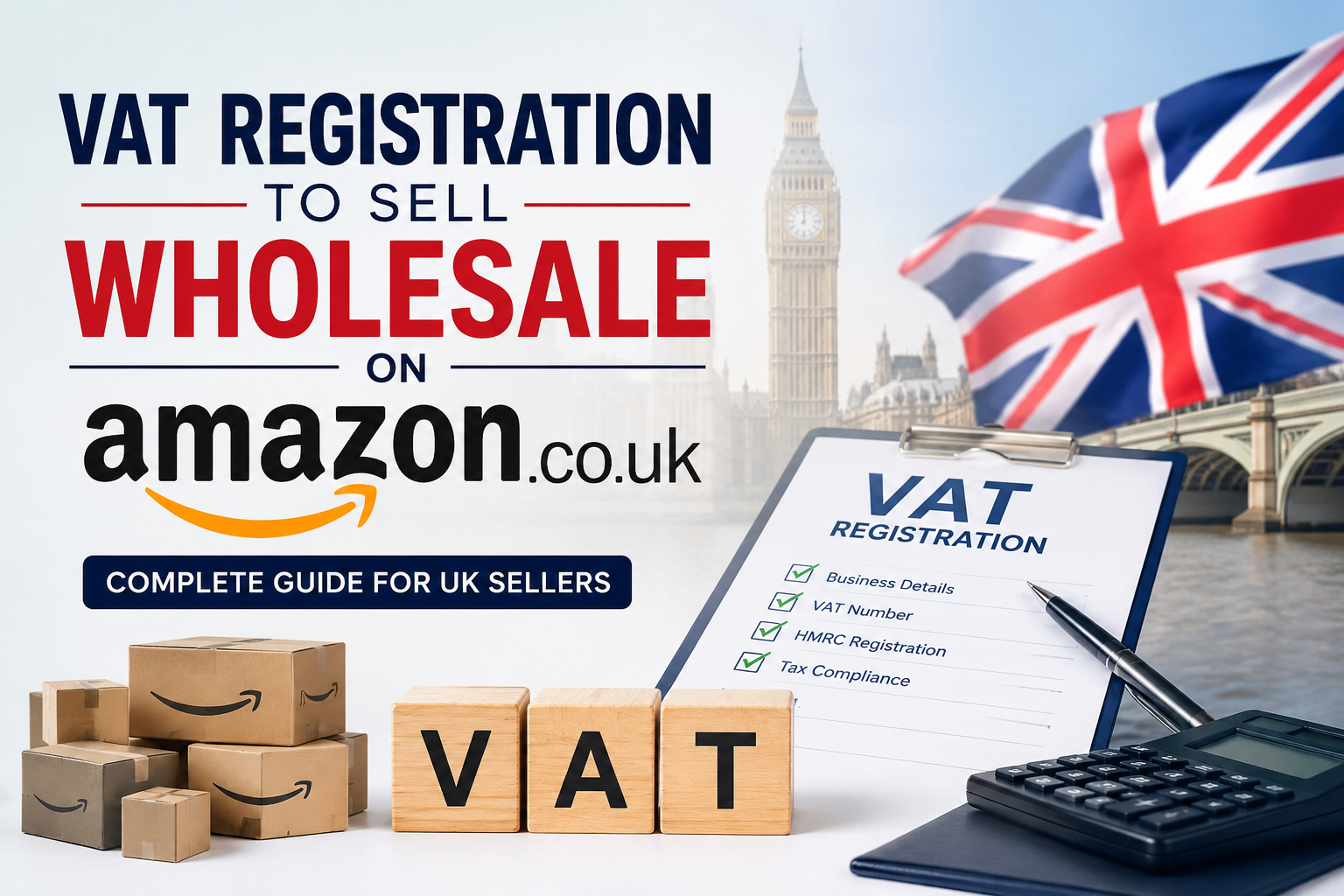
If you are starting a wholesale business on Amazon UK, the VAT question probably feels like a wall. The rules sound complicated, the advice online contradicts itself, and getting it wrong can mean a backdated tax bill or a suspended Amazon account. The good news: once you separate a few simple ideas, your own answer becomes clear.
This guide explains, in plain English, exactly when you need to register for VAT to sell wholesale on Amazon UK, when you do not, and the one detail that catches out thousands of sellers every year. We will use simple examples so you can see where you fit.
If you are a UK-based business, you do not need to be VAT registered to sell wholesale on Amazon UK until your taxable turnover passes £90,000 in any rolling 12-month period. Below that, registration is optional. If you are an overseas seller who stores stock in a UK Amazon warehouse, the threshold is £0, so you must register before your first sale. UK law does not require a VAT number to purchase wholesale below the registration threshold, though suppliers and Amazon may still ask for one.
- What VAT actually is, in plain words
- Buying wholesale vs selling: two different questions
- If you are a UK-based seller
- If you are an overseas seller (the zero threshold)
- Why Amazon collecting VAT does not let you off
- Why wholesale suppliers ask for a VAT number
- Should you register voluntarily?
- How to register for VAT, step by step
- Costly mistakes to avoid
- Frequently asked questions
Key Takeaways
- UK-based sellers must register for VAT once taxable turnover passes £90,000 in any rolling 12-month period. Below that it is optional.
- Overseas sellers storing stock in a UK Amazon warehouse have a threshold of £0 and must register from the first sale.
- Purchasing wholesale does not legally require a VAT number below threshold, though many commercial suppliers ask for one to confirm you are a real business.
- Amazon collecting VAT on some sales does not remove your duty to register when the rules say you must.
- The £90,000 figure is about your sales turnover, not how much stock you buy.
- Registering voluntarily can help or hurt your margins, it depends on who your customers are.
What VAT Actually Is, in Plain Words
VAT stands for Value Added Tax. It is a tax added to most goods and services sold in the UK. The standard rate is 20%. A few things have a reduced 5% rate or are zero-rated, but for most wholesale products you will deal with the 20% rate.
Here is the simple version. When a business is VAT registered, it adds 20% VAT on top of its prices and passes that money to HMRC, the UK tax authority. In return, it can claim back the VAT it paid on its own business purchases. The final customer is the one who really carries the cost. Everyone in the middle is just collecting and passing it along.
Being “VAT registered” simply means you have signed up with HMRC to do this. You get a VAT number, you charge VAT on your sales, you reclaim VAT on your costs, and you file a VAT return (usually every three months).
You are VAT registered and sell a product for £10 plus VAT. The customer pays £12. That extra £2 is not yours, you send it to HMRC. But if you paid £2 of VAT when buying supplies for your business, you subtract that, so you only hand over the difference. VAT is a flow-through, not a straight cost, once you are registered.
Buying Wholesale vs Selling: Two Different Questions
This is where most confusion starts, so let us clear it up first. There are two separate questions hiding inside “do I need VAT to sell wholesale on Amazon.”
- Do I need a VAT number to buy from wholesale suppliers? Legally, no. You do not need to be VAT registered to open a wholesale account or buy stock.
- Do I need to be VAT registered because I am selling on Amazon? This depends on where you are based and how much you sell. This is the real question, and the rest of this guide answers it.
People mix these up because suppliers often ask for a VAT number during the wholesale application. That request is about looking credible, not a legal rule (more on that below). Selling is where the actual legal obligation lives.
“Wholesale” describes how you buy. “VAT registration” is about how much you sell and where you are based. They are related but separate. You can buy wholesale without a VAT number, and whether you need to register depends on your sales, not your purchases.
If You Are a UK-Based Seller
This is the most common situation, and the rule is refreshingly simple.
If your business is established in the UK, you must register for VAT once your taxable turnover goes over £90,000 in any rolling 12-month period. “Rolling” means any 12 months, not just your accounting year, so you check the last 12 months on an ongoing basis. This threshold has been £90,000 since April 2024.
Below £90,000, you do not have to register. You can sell wholesale products on Amazon UK as a small business without a VAT number, as long as you stay under that level. Once you cross it, you must tell HMRC within 30 days.
Sophie runs a UK business selling wholesale kitchen products on Amazon. In her first year she sells £45,000 worth of goods. She is well under £90,000, so she does not need to register for VAT. She keeps an eye on her rolling 12-month total. When her sales climb toward £90,000, she registers. Simple.
One important detail: taxable turnover means your total sales of VAT-able goods, added up across every channel. If you sell on Amazon, eBay, and your own website, you combine them all. It is not £90,000 per platform, it is £90,000 across your whole business.
If You Are an Overseas Seller (the Zero Threshold)
Here is the detail that catches out thousands of sellers every year. If you are not established in the UK, the £90,000 threshold does not apply to you at all. Your threshold is zero.
In tax language you are a “non-established taxable person,” or NETP. If you store stock in a UK Amazon fulfilment centre (which is what FBA does), HMRC treats that as making taxable supplies in the UK from the very first sale. So you must register for UK VAT before you start selling, no matter how small your business is.
Many overseas sellers assume the famous £90,000 threshold protects them. It does not. The moment your inventory lands in a UK FBA warehouse, your registration threshold is £0. Selling even one unit without registering can lead to backdated VAT bills, penalties, and a suspended Amazon account.
Ahmed lives outside the UK and sends his wholesale stock to a UK Amazon warehouse to sell through FBA. Even though he has made zero sales so far, his threshold is £0 because he is storing goods in the UK. He needs to register for UK VAT before his first sale. If he waited until £90,000 like a UK business would, he would be breaking the rules from day one.
If this is you, it is worth understanding the full picture of setting up in the UK. Our guides on forming a business and sorting out banking as a non-resident walk through the practical steps, and you can browse our directory of wholesale distributors in the UK to find suppliers already set up for the UK market.
Why Amazon Collecting VAT Does Not Let You Off
This part confuses even experienced sellers, so let us make it clear.
Under UK “marketplace facilitator” rules, Amazon sometimes acts as the “deemed supplier.” That means for certain sales, especially sales by overseas sellers to UK customers, Amazon collects the VAT at checkout and sends it to HMRC for you. On the surface it looks like Amazon is handling your VAT, so you might think you are off the hook.
You are not. Amazon collecting the output VAT on a sale does not remove your legal duty to register for VAT when the rules require it. The obligation to register and the question of who physically collects the tax are two separate things. An overseas seller storing stock in the UK still has to be VAT registered, even though Amazon may be collecting the tax on their sales.
Amazon collecting VAT is like a shop collecting a deposit on your behalf. It does not change whether you were legally required to have an account in the first place. Your registration duty stands on its own.
Why Wholesale Suppliers Ask for a VAT Number
When you apply for a wholesale account, many suppliers ask for a VAT number. Since you now know a VAT number is not legally required to buy wholesale, why do they ask?
Because it is a quick way to check you are a legitimate commercial enterprise instead of someone attempting to buy at trade prices for personal use. A VAT number is easy proof of a genuine business. It is a filter, not a legal gate.
The good news: if you do not have a VAT number, you are not stuck. Plenty of suppliers work with businesses below the VAT threshold. You can usually prove you are a real business other ways, with your company registration, a business bank account, a professional website, and a trading history. We cover this in depth in our guide on how to get approved for wholesale accounts, which applies whether or not you are VAT registered.
The Simple Rule
A VAT number helps you get approved faster with some suppliers, but a lack of one is not a dead end. Focus on looking like a legitimate business: registered company, business bank account, a simple website, and clear contact details. Many suppliers care about that far more than a VAT number.
Should You Register Voluntarily?
Even if you are under £90,000 and not required to register, you are allowed to register voluntarily. Sometimes it is smart, sometimes it costs you money. It depends on who you sell to.
Voluntary registration can help when most of your costs carry VAT that you would like to reclaim, or when your customers are themselves businesses that can reclaim VAT (so the VAT you add does not really cost them). It also makes a small business look more established.
It can hurt when you sell mostly to ordinary consumers, because you then have to add 20% to your prices, which either makes you more expensive or eats into your margin. On Amazon, where most buyers are consumers, this matters a lot.
| Situation | Voluntary registration is… | Why |
|---|---|---|
| You sell mostly to consumers on Amazon | Often not helpful | You must add 20%, raising prices or cutting margin |
| You sell mostly to other businesses (B2B) | Often helpful | Business buyers reclaim the VAT, so it does not deter them |
| You have high VAT-able costs to reclaim | Can be helpful | You recover VAT on stock, fees, and supplies |
| You want to look bigger and established | A minor plus | A VAT number adds credibility with suppliers |
This is a genuine “it depends” decision, and it is worth a quick chat with an accountant before you register voluntarily. The wrong choice can quietly cost you margin on every sale.
How to Register for VAT, Step by Step
If you have decided (or are required) to register, the process is straightforward and free. You do not need to pay a service to do it, though many sellers use an accountant for convenience.
For the official rules and the latest details, HMRC’s own guide to how VAT works is the authoritative source, and worth a read before you register.
Costly Mistakes to Avoid
Most VAT problems are not complicated, they come from a handful of avoidable errors. Skip these and you avoid nearly every nasty surprise.
| The mistake | Why it hurts | Do this instead |
|---|---|---|
| Overseas seller assuming the £90,000 threshold applies | Backdated VAT and penalties from the first sale | Register before storing UK stock; your threshold is £0 |
| Thinking Amazon handles all your VAT | You miss your own duty to register | Register when the rules require, even if Amazon collects |
| Only checking turnover once a year | You cross £90,000 without noticing and register late | Track your rolling 12-month total monthly |
| Counting each platform separately | You think you are under when you are over | Add up all channels together |
| Registering voluntarily without doing the maths | You add 20% and lose margin on consumer sales | Check who your customers are first |
| Paying a website to get your VAT number or EORI | Wasting money on a free government service | Register directly on gov.uk |
The Practical Takeaway
If you are UK-based, you do not need VAT to sell wholesale on Amazon until you pass £90,000 in rolling 12-month turnover. If you are overseas and store stock in the UK, you must register from your first sale. Buying wholesale never legally requires a VAT number, though suppliers may ask. And Amazon collecting VAT never removes your own duty to register. Know which of these describes you, and the rest falls into place.
The best next step is a practical one. Work out which category you fall into, then get your suppliers lined up. You can browse verified wholesalers by category and location in the WholesaleSeeker directory, or if you supply other businesses, you can list your own business and reach buyers who are searching for wholesale partners right now.
Frequently Asked Questions
Do I need a VAT number to buy from wholesale suppliers in the UK?
No, a VAT number is not legally required to buy wholesale. Many suppliers ask for one as a quick way to confirm you are a genuine business, but plenty work with businesses below the VAT threshold. You can prove you are a real business with a company registration, a business bank account, and a professional website instead.
What is the VAT threshold for selling on Amazon UK in 2026?
For UK-established businesses, the threshold is £90,000 of taxable turnover in any rolling 12-month period. Once you cross it, you must register with HMRC within 30 days. For overseas sellers who store stock in a UK Amazon warehouse, the threshold is £0, meaning registration is required from the first sale.
I am an overseas seller using UK FBA. Do I really have to register from the first sale?
Yes. If you are not established in the UK and you store stock in a UK fulfilment centre, HMRC treats you as making taxable supplies from the start, so your threshold is £0. You must register for UK VAT before your first sale, regardless of how small your business is.
Amazon already collects VAT on my sales. Do I still need to register?
Often, yes. Amazon acting as the deemed supplier and collecting VAT on certain sales does not remove your own obligation to register when the rules require it. This is especially important for overseas sellers storing stock in the UK, who must be registered even though Amazon may collect the tax.
Does the £90,000 threshold count my Amazon sales only, or all my sales?
All of them. Taxable turnover is your total VAT-able sales across every channel combined, Amazon, eBay, your own website, and any others. It is not £90,000 per platform, it is £90,000 across your whole business.
Should I register for VAT voluntarily if I am under the threshold?
It depends on your customers. If you sell mostly to consumers, voluntary registration usually means adding 20% to your prices, which can hurt your margin. If you sell to other businesses or have high VAT-able costs to reclaim, it can be worth it. Speak to an accountant before deciding.
Is registering for VAT free, or do I have to pay?
Registering is free through the official gov.uk service. Be careful of third-party sites that charge a fee for something the government provides for nothing. Some sellers still choose to use an accountant for convenience, but the registration itself costs nothing.
This guide explains the general rules in plain language to help you understand your position. It is not tax advice. VAT rules have exceptions, and your situation may have details that change the answer. For a decision specific to your business, check the official guidance on gov.uk or speak with a qualified accountant.
Find your wholesale suppliers
Browse verified UK and international wholesalers by category and location, and build your shortlist in minutes.


2 Comments
Pingback: Cheapest Way to Form a UK LTD in 2026
Pingback: UK Business Bank Account for Non-Residents