

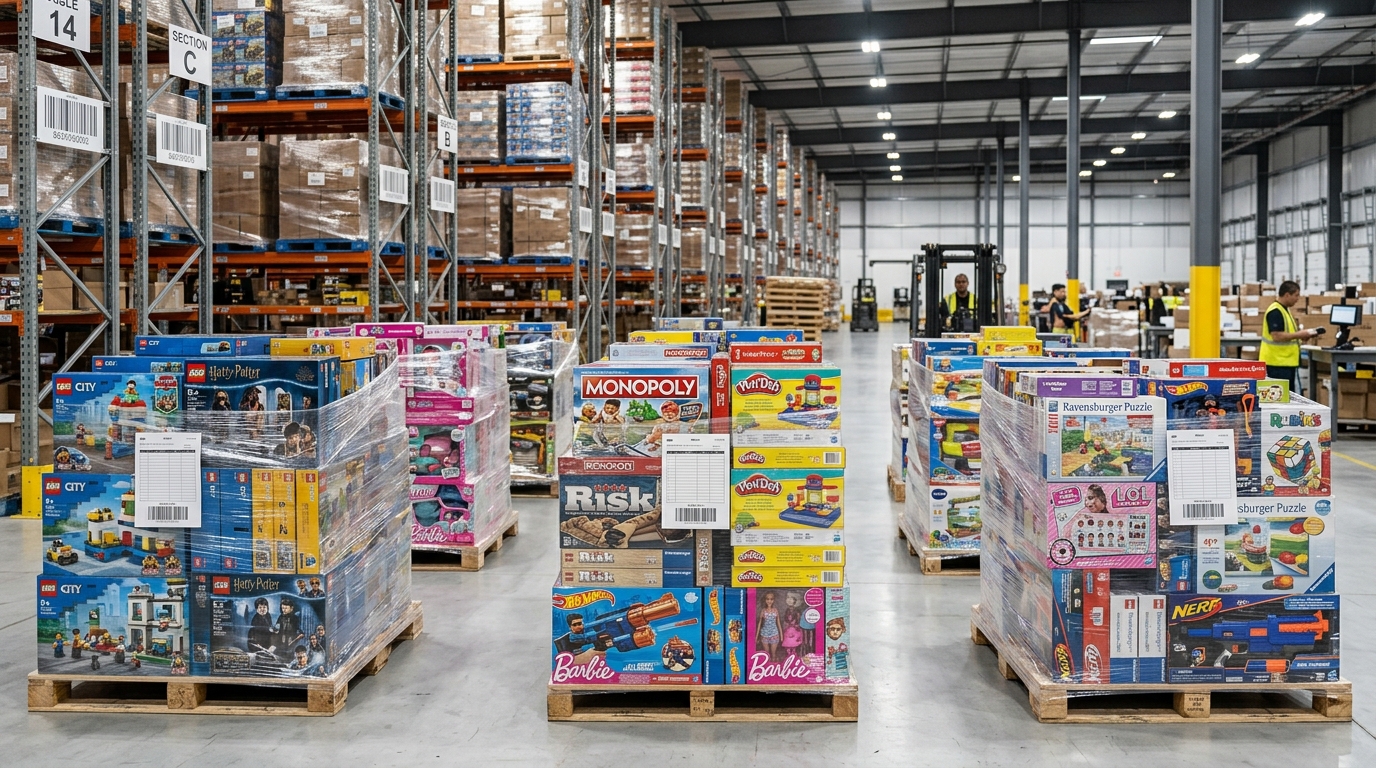
What a Toy Pallet Actually Is
A toy pallet contains bulk quantities of toys stacked and shrink-wrapped on a standard 48×40 wooden shipping pallet. Big-box department stores, online marketplaces, and toy manufacturers liquidate these units when they must clear warehouse space, write off seasonal lines, or dispose of customer return inventory.
Liquidation inventory originates from three primary sources:
Overstock: Brand-new, factory-sealed products that never sold during their primary retail window. These units require zero cleaning or repair and sell closest to standard retail prices.
Shelf Pulls: Products removed from store shelves during floor plan updates, brand packaging changes, or post-holiday markdowns. The items are unused, though packaging may have clearance stickers, security tags, or minor edge shelf wear.
Customer Returns: Merchandise brought back to physical stores or shipped back to fulfillment centers. The condition ranges widely from unopened boxes to lightly played toys, missing pieces, or cosmetic carton damage.
Toys remain one of the most consistent categories for secondary market resellers. Recognized brands like Hasbro, Mattel, Lego, Barbie, and Nerf retain strong organic search volume year-round, with demand peaking sharply between October and December.
Where to Buy Toy Pallets and Top Sources
Selecting the right liquidation channel depends on your working capital, operational storage, and access to freight handling. Sourcing options fall into three main channels.
1. Major liquidation auction platforms
Liquidation.com is an established clearinghouse for retail surplus. It runs daily auctions for single pallets, multi-pallet bundles, and full 53-foot truckloads. The marketplace provides manifests detailing item titles and estimated retail values. Buyers must factor in platform buyer premiums and freight before placing bids.
B-Stock operates private liquidation marketplaces directly on behalf of major retailers like Walmart, Target, and Amazon. Resellers bid directly on inventory released by corporate returns facilities, cutting out middleman brokers. Individual retail storefronts on B-Stock require separate buyer registration and tax ID validation.
Direct Liquidation features merchandise sourced from top American retail chains. The platform offers both auction bidding and instant buy-it-now lots with detailed manifests and condition indicators.
2. Fixed-price and beginner-friendly platforms
BULQ publishes fixed-price lots ranging from small parcel cases to full pallets. Inventory is manifested with guaranteed piece accuracy, and freight costs are quoted upfront ($30 flat-rate per case or fixed pallet rates). This predictability helps new sellers learn the economics without auction volatility.
888 Lots offers manifested lots with itemized UPC barcodes, Amazon ASIN references, historical sales velocity data, and an integrated profit calculator. A valid state resale certificate is mandatory to open a purchasing account.
3. Regional wholesale liquidators and closeout distributors
Via Trading operates a 240,000-square-foot warehouse in Los Angeles, California. They offer wholesale toys in case packs, individual pallets, and truckloads. Buyers can inspect lots on site and arrange local pickup, completely avoiding freight shipping fees.
Sourcing from regional liquidation facilities in your home state reduces shipping overhead. Because toys are bulky and heavy, long-distance freight can absorb a substantial portion of your gross profit. You can find regional distributors and local trade sources through our verified Wholesale Toys and Hobbies Directory.
Explore Verified Wholesale Toy Suppliers
Browse contact-ready toy distributors, liquidation specialists, and closeout houses across the USA and North America.
View Toy Suppliers DirectorySource Comparison Table
| Supplier | Pricing Model | Best Use Case | Manifest Quality | Entry Barrier |
|---|---|---|---|---|
| Liquidation.com | Online Auction | Volume buyers, pallets and truckloads | Itemized manifest included | Moderate capital |
| B-Stock | Retailer Auctions | Direct corporate return streams | Varies by enterprise seller | Resale certificate required |
| Direct Liquidation | Auction and Fixed Price | Tier-one department store surplus | Manifest with condition tags | Moderate capital |
| BULQ | Fixed Price | Beginner sellers testing inventory | Guaranteed piece accuracy | Low capital ($300+) |
| 888 Lots | Fixed Price | Data-driven Amazon and eBay resellers | Detailed UPC and ASIN metrics | Resale certificate required |
| Via Trading | Fixed and Local Pickup | West Coast buyers avoiding freight | Sample manifests and on-site visits | Low to moderate capital |
Toy Conditions and Grades Explained
Liquidation suppliers categorize inventory by standard condition grades. Understanding these designations ensures you budget adequate prep labor before listing items for sale.
| Condition Grade | Operational Description | Resale Performance |
|---|---|---|
| Overstock and Factory New | Sealed product in original retail boxes with intact factory seals. | Sells at standard market price with minimal preparation time. |
| Shelf Pulls | Unsold store inventory. Packaging may display clearance stickers or shelf friction. | High sell-through rate; minor cosmetic discounts may apply. |
| Customer Returns | Items returned by retail customers. Conditions range from unused to defective. | Requires systematic testing, part counting, and box repackaging. |
| Salvage and As-Is | Items flagged with physical damage, missing components, or heavy wear. | Sold at scrap rates; suited for spare parts or bundling. |
Electronic and battery-operated toys require thorough testing. Remote control vehicles, digital game consoles, and animatronic plush animals frequently arrive with depleted battery terminals or missing remotes. If a collectible action figure or board game arrives with a broken seal, inspect the internal pieces before creating a listing. Missing parts or unexpected wear lead directly to customer complaints and platform penalties.
What Toy Pallets Cost and How to Price Them
Secondary market toy pallets generally sell between 10% and 30% of the manufacturer suggested retail price (MSRP) shown on the manifest. A pallet listing $4,000 in retail merchandise typically sells for $400 to $1,200 depending on brand strength, condition grade, and market liquidity.
Accurate valuation requires calculating total landed cost to account for freight and fees alongside the auction bid price. Essential cost items include:
1. Purchase Price: The hammer price or fixed checkout rate.
2. Buyer Premium: Auction platforms typically add a 5% to 15% surcharge to the final bid.
3. LTL Freight Shipping: Freight carriers charge between $150 and $550 per pallet based on distance, liftgate requirements, and residential service.
4. Processing Supplies: Poly bags, suffocation warning labels, barcode labels, and test batteries.
Run your estimated profit margins before committing funds. You can verify net proceeds after platform commissions with our Amazon FBA Profit Calculator and model bulk unit pricing using the Wholesale Price Calculator.
Resellers apply the 20 percent benchmark when evaluating manifests: calculate whether the top 20 percent of items by value can recoup the entire landed cost of the shipment. When top-tier items cover all upfront expenses, the remaining 80 percent of the pallet generates pure net income.
- Overstock and shelf pulls provide predictable margins with zero testing requirements.
- Beginners reduce risk by purchasing fixed-price manifested lots from BULQ or 888 Lots before competing in live auctions.
- Always calculate landed cost by combining purchase price, buyer premium, freight, and supplies before placing a bid.
- Source from regional warehouses or schedule local warehouse pickups to eliminate high freight charges.
- Inspect all customer return boxes and test electronics before listing on public marketplaces.
- Partner with professional fulfillment specialists through our Prep and 3PL Services Directory if you lack dedicated warehouse space.
How to Vet a Toy Liquidation Supplier
The secondary wholesale market contains legitimate enterprise liquidators alongside unauthorized brokers. Applying basic due diligence protects your business capital.
Before submitting applications to distributors, ensure your corporate entity is formed to receive tax-exempt wholesale pricing. Review our ranking of the cheapest state to form an LLC for resellers to secure your resale certificate without unnecessary state fees. Require an itemized manifest for every overstock or shelf-pull lot. Established distributors routinely share downloadable manifests with UPCs, item names, and piece quantities. Be cautious of sellers offering unmanifested mystery pallets at prices that seem unusually low. For high-value building sets, retailers should differentiate between mystery liquidation pallets and pristine inventory ordered directly through authorized LEGO wholesale distributors that provide factory warranties and clean retail invoices.
Verify commercial registrations and physical warehouse locations. Cross-reference addresses on satellite mapping and inspect commercial reviews across independent industry groups. Reputable sellers accept credit cards or standard corporate bank transfers. Avoid brokers demanding non-traceable wire transfers, gift cards, or peer-to-peer payment apps.
Start with a single trial pallet when initiating business with a new distributor. Evaluating the shipment firsthand gives you accurate insight into their grading standards, packaging care, and manifest reliability.
Where to Resell Liquidated Toys
Maximizing revenue requires routing each toy to the sales channel that yields the highest net recovery:
Amazon FBA: The preferred channel for pristine, factory-sealed overstock and shelf pulls with valid UPC barcodes. Check whether specific brand restrictions apply to your seller account before purchasing major names like Lego, Fisher-Price, or Disney. If you source wholesale goods, consult our guide to Amazon FBA Wholesale Distributors.
eBay: Excellent for opened boxes, collectible vintage toys, rare action figures, and incomplete sets sold for replacement parts.
Local Marketplaces and Flea Markets: Facebook Marketplace, OfferUp, and community swap meets move unmanifested customer returns, large ride-on toys, dollhouses, and plush lots without shipping friction.
Mercari and Poshmark: Strong conversion channels for designer toys, action figure sets, and children’s boutique merchandise.
Glossary
- Manifest
- An itemized inventory sheet detailing piece counts, product names, UPC barcodes, and estimated retail values for every item on a pallet.
- Overstock
- Factory-new, unsold merchandise cleared out by retailers to free warehouse capacity.
- Shelf Pulls
- Merchandise removed from retail store displays due to packaging revisions, inventory rotation, or post-season markdowns.
- Customer Returns
- Merchandise returned to retail stores or fulfillment warehouses, exhibiting varied physical conditions.
- Salvage
- Severely damaged or defective goods sold as-is for spare parts or raw material recycling.
- LTL Freight
- Less-Than-Truckload freight shipping used to move between one and six pallets via commercial truck.
- Buyer Premium
- A percentage fee added to the winning bid price by an auction platform, typically 5% to 15%.
- Landed Cost
- The all-inclusive expenditure needed to place inventory on your warehouse shelf, combining purchase price, platform fees, freight, and prep supplies.
Frequently Asked Questions
How much does a toy pallet cost?
Most toy pallets sell for 10% to 30% of their total retail manifest value. Resellers typically pay between $300 and $2,000 per pallet, depending on brand mix, condition grade, and whether the lot contains brand-new overstock or raw customer returns.
Where can I buy pallets of toys online?
Top online platforms include Liquidation.com, B-Stock, Direct Liquidation, BULQ, 888 Lots, and Via Trading. Beginners often see better results starting with fixed-price manifested lots on BULQ or 888 Lots before participating in competitive auctions.
Are toy liquidation pallets profitable?
Toy liquidation pallets can generate steady profit margins when sourced with itemized manifests and timed for fourth-quarter holiday sales. Profitability depends on calculating full landed costs, systematically testing return items, and directing each unit to the appropriate resale marketplace.
What is the difference between overstock and customer-return toy pallets?
Overstock toys are brand-new, factory-sealed products that sell close to regular retail value with minimal prep work. Customer-return pallets cost less upfront but contain mixed conditions that require cleaning, testing, and component verification.
Do toy pallets come with a manifest?
Reputable sellers of overstock and shelf-pull lots provide detailed manifests listing product titles, UPC codes, quantities, and retail pricing. Salvage and unmanifested mystery lots carry lower upfront costs but present higher risk.
Source Quality Toys for Your Reselling Business
Connect with vetted wholesale toy distributors, liquidation specialists, and prep centers in the WholesaleSeeker directory.
Explore Wholesale Toy Directory


1 Comment
Pingback: LEGO Wholesale Distributors in USA: Authorized 2026 List