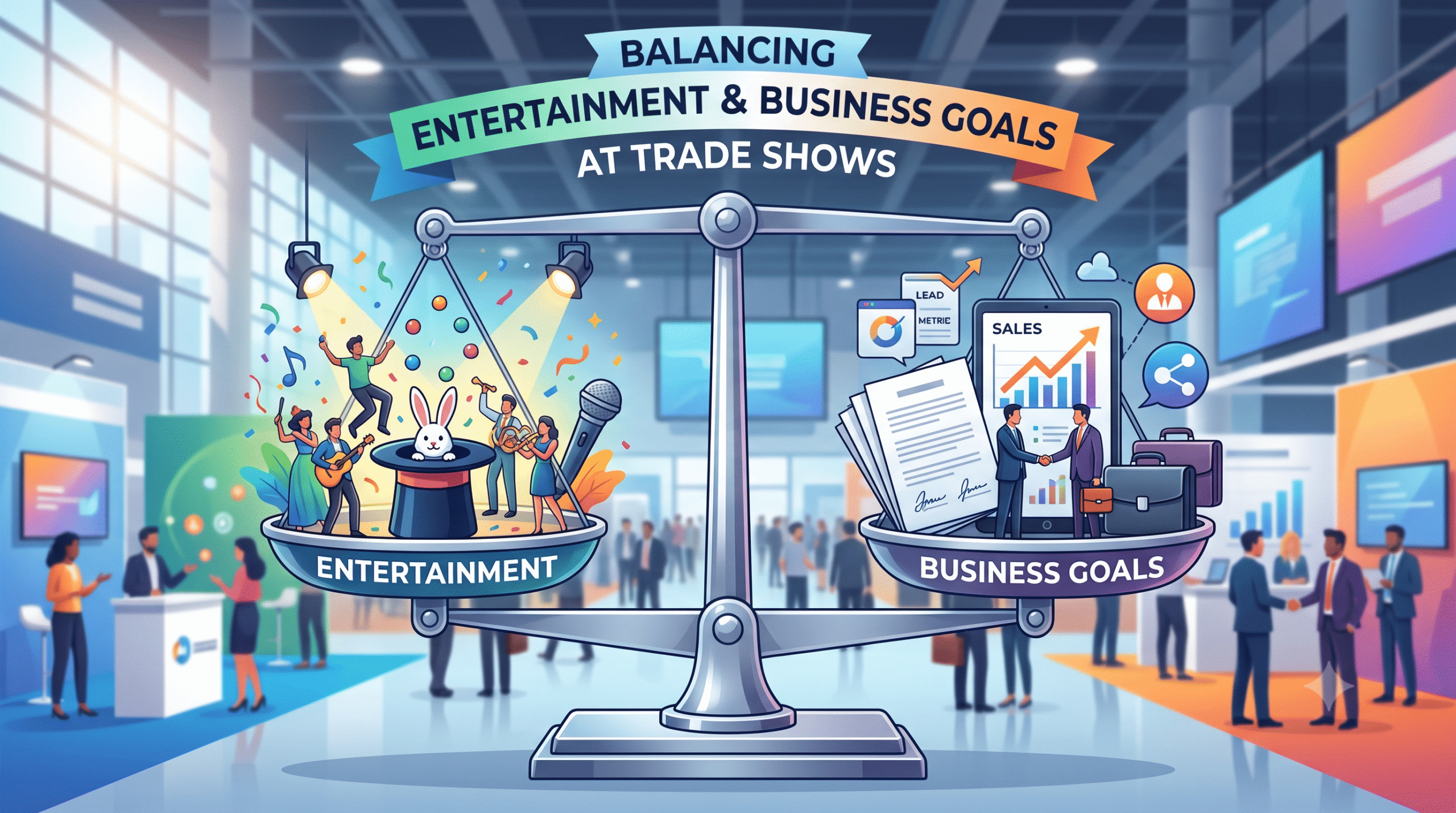
Trade shows are often judged by two very different scorecards. One is emotional and immediate. It asks whether the booth felt alive, whether attendees smiled, whether people stopped long enough to notice the brand, and whether the experience broke through the blur of a crowded exhibition hall. The other is commercial and disciplined. It asks how many qualified conversations took place, how many prospects moved forward, whether the team met decision makers, and whether the investment produced measurable value.
The tension between those scorecards explains why so many exhibitors struggle to get trade show strategy right. A booth that is all spectacle can generate traffic without producing serious leads. A booth that is all business can feel flat, forgettable, and easy to walk past. The real objective is not to choose between energy and rigor. It is to combine them in a way that serves the company’s market position, sales process, and brand reputation.
That balance requires more than a clever activation or a polished sales deck. It demands a clear operating philosophy for the event, one that treats entertainment as an engagement asset instead of a distraction and treats business goals as the framework that gives creative ideas purpose. The strongest exhibitors understand that attention is only the first win. The deeper win comes from turning attention into trust, trust into conversation, and conversation into action.
What This Guide Covers
- Start with strategic intent, not booth features
- Understand why people stop and why they stay
- Design experiences that support the sales conversation
- Train staff to shift from energy to substance
- Build a booth journey instead of a single moment
- Measure what matters beyond foot traffic
- Protect brand credibility while creating delight
- Align pre-show, on-site, and post-show efforts
Start With Strategic Intent, Not Booth Features
The most effective trade show programs begin long before anyone discusses booth graphics, games, demos, or giveaway items. They begin with a precise view of what the company needs the event to accomplish. That may include launching a product, accelerating a pipeline, meeting channel partners, repositioning the brand, or entering a new segment. When leadership is not aligned on the primary objective, the booth tends to become a compromise of disconnected ideas. What looks exciting in planning can become confused in execution because every element is trying to satisfy a different agenda.
A focused strategic brief helps prevent that drift. It should identify the target audience, define success in measurable terms, and explain what kind of impression the brand wants to leave. It should also distinguish between primary and secondary goals. A company may want to generate leads, support a new product launch, and improve brand awareness, but those goals do not carry equal weight. Ranking them forces better decisions about staffing, content, design, and programming.
That planning matters because booth games work best when they support the event strategy, not when they are added as a last-minute gimmick. Brands looking to make their booths more engaging often work with firms like Something New, whose trade show booth games are designed to attract attendees, encourage participation, and give staff an easier way to start meaningful conversations. Done well, these activations can support lead capture, product education, dwell time, and brand recall. The goal is not simply to make a booth more entertaining. It is to use play with commercial purpose, so attendees have a reason to stop, engage, and remember the brand.
Understand Why People Stop and Why They Stay
Trade show visitors make rapid judgments in crowded environments. They scan booths in seconds and decide whether a display looks relevant, approachable, and worth the time. Entertainment can help earn that first pause because it signals movement, energy, and social proof. A crowd suggests that something interesting is happening. But a crowd alone is not enough if the people gathered are not the people the business needs to reach.
That is why exhibitors should think in two stages. The first stage is attraction. The second is retention. Entertainment often excels at attraction because it creates visual and emotional momentum. Retention depends on whether the booth quickly communicates business value, relevance, and a reason to engage further. If attendees cannot understand what the company does, who it serves, or why it matters, the activation may create a brief spike in foot traffic without any durable commercial return.
The strongest booths are designed to answer both questions at once. They give people a reason to stop and an equally strong reason to stay. That can happen through a skilled host who connects the activity to the company’s offering, through signage that clarifies the value proposition, or through a guided experience that moves naturally from fun to substance. The goal is not to trap attendees in an experience. It is to respect their time while making the next step feel easy, relevant, and worthwhile.
Design Experiences That Support the Sales Conversation
Entertainment works best at a trade show when it is engineered to serve the sales process. That does not mean every interaction must feel scripted or transactional. It means the experience should open a path to a meaningful business exchange. If a game, demonstration, or interactive moment creates excitement but leaves staff with no natural way to ask qualifying questions, the booth is carrying cost without capturing enough value. The experience must be designed with the conversation in mind.
One practical way to do this is to build the activation around a business theme. A cybersecurity company might use a challenge that reflects speed, pattern recognition, or risk management. A logistics firm might create an activity tied to timing, precision, or coordination. A healthcare technology brand might design interaction around ease, accuracy, or patient flow. When the entertainment mirrors the company’s value proposition, staff gain a simple narrative bridge from play to product relevance. The visitor does not feel sold to abruptly because the connection feels coherent from the start.
This also improves the quality of follow-up. Sales teams can refer back to the experience as a shared point of memory, which makes later outreach more specific and more human. Instead of sending a generic note after the event, they can reference the interaction, the conversation it sparked, and the problem the prospect described. That kind of continuity matters because trade show leads often cool quickly after attendees return to crowded inboxes and daily pressures. A well-structured booth experience gives the company a distinctive story to continue after the hall goes quiet.
Train Staff to Shift Gracefully From Energy to Substance
Booth design gets attention, but staff behavior determines whether that attention turns into results. A lively activation can create momentum, yet poorly prepared staff can waste it in minutes. Some teams are so focused on being welcoming that they fail to qualify opportunities. Others swing too hard in the opposite direction, turning every interaction into a blunt sales pitch. The right balance depends on training people to read cues, manage transitions, and match tone to the attendee in front of them.
That transition is where many exhibitors lose ground. A visitor may approach because the booth feels fun and accessible, but the moment a representative speaks, the tone can become stiff or overly aggressive. That shift breaks the experience. Staff should be able to move from light engagement into serious conversation without making the attendee feel cornered. Good openers are simple, curious, and contextual. They build off what just happened in the booth and invite substantive commercial dialogue instead of reciting a rehearsed monologue.
Training should also reflect the fact that not every booth visitor deserves the same level of attention. Some people are ideal prospects. Some are partners, media contacts, or industry peers. Some are simply curious passersby. Staff need a shared framework for how to welcome broadly while prioritizing intelligently. That includes handoff protocols, lead capture rules, meeting escalation signals, and a clear understanding of which conversations should move deeper and which should end politely. Entertainment can create access. Training determines whether the brand capitalizes on it.
Build a Booth Journey Instead of a Single Moment
Many exhibitors think about engagement as a single point of impact. They focus on the hook, the gimmick, or the attraction that gets attention from the aisle. But trade show performance usually improves when the booth is designed as a journey with distinct stages. The first stage pulls people in. The second helps them understand the company. The third qualifies interest. The fourth creates a clear next step. When those stages are missing, even a popular booth can become operationally messy and commercially weak.
A strong booth journey organizes both entertainment and business functions in physical space. The outer edge may be energetic and inviting, built for visibility and low-pressure interaction. The middle area can support guided conversations, product storytelling, or short demonstrations. The inner area can serve as a place for deeper meetings, consultations, or deal discussions. This layered approach lets the booth feel dynamic without becoming chaotic. It also helps different kinds of attendees engage at the level that suits their interest and available time.
This kind of flow protects the brand from a common trade show mistake, which is forcing every visitor into the same funnel. Some attendees want a quick overview. Some want to assess fit in five minutes. Others arrive ready for a serious commercial conversation. A thoughtful booth layout accommodates all three without sacrificing clarity. Entertainment should be positioned as an entry point, not as a traffic jam. When the physical environment supports progression, staff can move people naturally from energy to intention.
Measure What Matters Beyond Foot Traffic
It is easy to overvalue visible busyness at a trade show. Crowds look impressive. Social sharing can feel like proof of success. Team morale often rises when a booth appears packed. But traffic is only one layer of performance, and often not the most important one. A smaller number of high-value conversations can matter far more than a large number of casual interactions. Companies that balance entertainment and business well are disciplined about what they measure and why.
That measurement should begin with objective categories agreed on before the event. These may include qualified leads, meetings booked, product demos completed, partner introductions, press mentions, sales opportunities created, or post-show conversion rates. Entertainment can and should be evaluated too, but in terms that connect to business outcomes. Did the activation increase dwell time among target buyers. Did it improve staff access to senior decision makers. Did it give the team more natural openings to qualify prospects. Those are more useful questions than simply asking whether people seemed to enjoy it.
Post-show analysis should also include qualitative feedback. Staff often know which elements drew the right audience and which attracted people with little commercial relevance. Prospects may reveal whether the booth experience clarified the company’s value or obscured it. Leaders should evaluate engagement quality and inquiry patterns. If the activation generated strong traffic but weak lead quality, the problem may be targeting or messaging. If lead quality was strong but traffic was soft, the problem may be visibility or energy. Measurement gives future creativity a sharper edge.
Protect Brand Credibility While Creating Delight
Entertainment at a trade show is most effective when it reinforces brand credibility instead of competing with it. That distinction matters, especially in industries where trust, expertise, and professionalism are central to the buying decision. A financial services firm, enterprise software provider, or healthcare company may benefit from playfulness, but not from anything that makes the brand seem careless or unserious. The art is to create delight without undermining authority.
This is where tone becomes critical. Not every audience responds to the same type of activation, and not every event carries the same cultural expectations. A premium B2B audience may appreciate elegance, wit, and subtle interactivity more than high-volume spectacle. A consumer-facing event may reward more visible excitement. Neither approach is inherently better. The choice depends on brand position, customer expectations, and the nature of the buying cycle. Entertainment should feel like an expression of the brand, not a costume it puts on for the event floor.
Credibility is also reinforced by execution quality. Details matter. Signage should be clear. Hosts should be polished. Wait times should be managed. Follow-up materials should be aligned with the experience attendees had in the booth. A playful concept that is poorly organized can damage confidence more than a modest concept that is delivered flawlessly. In trade show environments, people often infer operational competence from small signals. If the booth feels smart, intentional, and well run, the brand earns permission to be memorable.
Align Pre-Show, On-Site, and Post-Show Efforts
A balanced trade show strategy does not begin when the booth opens, and it does not end when the crates are packed. Pre-show outreach, on-site execution, and post-show follow-up must operate as one connected system. Entertainment may be the most visible piece on the floor, but it becomes more valuable when it is supported by advance messaging and disciplined follow-through. Otherwise the event risks becoming a burst of activity with no lasting commercial impact.
Before the show, exhibitors should set appointments, preview booth experiences, and brief attendees on why visiting will be worth their time. This can be done through email, social channels, customer outreach, partner networks, and sales team invitations. The key is to structure the exhibit booth as an engaging business destination with relevance. Prospects should understand what they can learn, whom they can meet, and what problem the company can help solve. That context improves the odds that booth traffic will include qualified corporate buyers alongside general expo attendees.
After the show, the follow-up strategy should reflect the nuance of what happened on site. A visitor who had a brief interaction should not receive the same message as a decision maker who spent twenty minutes in a product discussion. Teams should sort leads by intent, capture useful conversation notes, and move quickly while the memory of the event is still fresh. The companies that win trade shows are usually not the ones that were simply the most entertaining on the day. They are the ones that used entertainment to spark momentum and then converted that momentum through organization, relevance, and speed.
The best trade show experiences do not treat fun and business as competing forces. They treat fun as a tool that lowers barriers, creates openness, and gives the brand a chance to be remembered in a crowded marketplace. When entertainment is disconnected from business goals, it becomes noise. When business goals ignore attention, curiosity, and emotion, the booth becomes forgettable. Used with precision, fun is not a compromise. It is the strategy.