Look at any Amazon listing and you will see who sells the product. What you will never see is who supplies it. Finding legitimate wholesale suppliers is the foundation of a sustainable Amazon business, yet most new sellers make critical mistakes about where their wholesale suppliers actually come from.
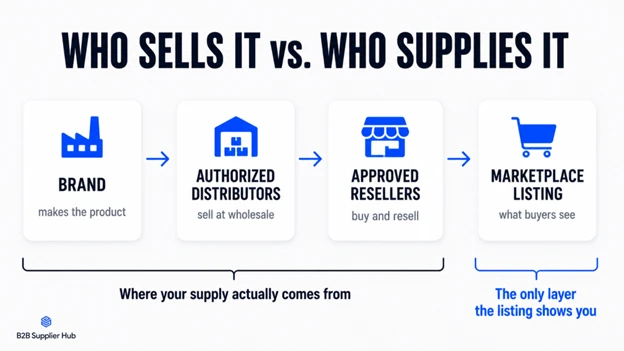
The sellers on a listing are just the visible layer. Behind them sits a supply chain the listing never shows you: the brand, its authorized distributors, and the rules that decide who gets to buy at wholesale. That hidden layer is the one that matters if you want to last in this business. Here are the four mistakes sellers make about it and what the real picture looks like.
- Assuming the sellers on a listing are the source
- Treating a below-retail price as proof of legitimacy
- Confusing finding a distributor with getting approved
- Paying for directories with no prices or stock data
- The real supply chain, from brand to approved reseller
Mistake 1: Assuming the Sellers on a Listing Are the Product’s Source
New sellers see 12 companies on a listing and assume some of them will supply the product. Almost never. Those sellers are your competitors, buying from the same sources you are trying to find.
The real question sits a layer deeper: which distributors did the brand authorize, and which of them will open an account for you? Search any popular power tool, and you will find a dozen sellers on the listing. Not one of them will sell you a case at wholesale. The company that will is one the listing never names.
A listing proves demand exists. It tells you nothing about where the product comes from.
Mistake 2: Treating a Below-Retail Price as Proof of a Legitimate Supplier
A price below retail is not proof you are buying from the right place. Products reach the market through very different channels: brand-authorized distribution, middlemen reselling someone else’s allocation, and gray market goods that arrive through channels the brand never sanctioned. The price can look identical across all three. The consequences do not.
Industry surveys put the share of Amazon sellers hit by an account suspension in 2024 at roughly a third, and attorneys who handle reinstatements report inauthentic-item complaints as the single most common reason accounts go down, with weak sourcing documentation as the leading cause behind them. A real invoice from the wrong kind of supplier still fails the moment a brand challenges it.
Mistake 3: Confusing Finding a Distributor With Getting Approved by One
Here is the friction almost nobody warns you about: identifying a distributor and being approved by one are separate achievements. Distributors run their own vetting, business registration, resale certificates, and sometimes volume expectations or channel restrictions. Some brands go further and control which sellers their distributors may supply at all. (Need to set up your business entity? Review our guide to the cheapest state to form an LLC for Amazon FBA and resellers).
So the real sourcing workflow has two halves: find the right suppliers, then earn the account. Any resource that pretends the second half does not exist is setting you up for a surprise. Finding a brand’s authorized distributors is a learnable skill, as shown in our guide on how to find authorized LEGO distributors for independent toy and hobby storefronts. Getting approved is a relationship, and it starts with looking like a legitimate, prepared business.
Have your business registration, resale certificate, and a clear picture of your volumes ready. Applications that arrive complete get taken seriously. Applications that arrive as questions get queued.
Mistake 4: Paying for Supplier Directories With No Prices or Stock Data
The oldest trap in wholesale: directories that charge upfront for supplier names, with no prices, no stock information, and no way to know whether a single entry is worth contacting. The gamble structure is backwards. You pay before you have any information, then spend weeks discovering what you bought.
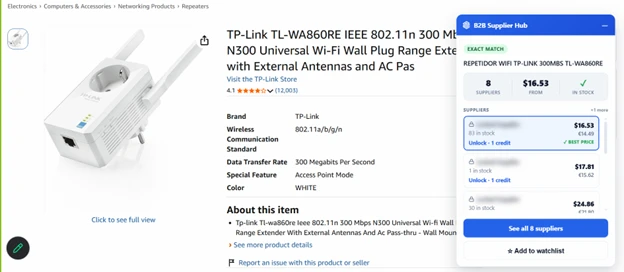
Whatever sourcing method you use, apply one test to it: can you see the numbers before you commit money? A supplier’s real relevance to your business is in its cost, its stock, and how fresh that data is. Names without numbers are trivia.
The Real Supply Chain: From Brand to Authorized Distributor to Approved Reseller
Products flow from brands, through authorized distributors, to approved resellers, and every gate in that chain exists on purpose. For instance, when sourcing high-demand culinary cutlery or outdoor blades, buying through a verified wholesale knife distributor ensures you receive genuine commercial invoices that pass marketplace verification. Four rules replace the four mistakes:
Sellers who internalize that picture stop making the expensive mistakes and start building the thing that actually compounds in wholesale: a bench of real, authorized supplier relationships that competitors on the listing cannot see and cannot copy.
The Practical Takeaway
The sellers on a listing are the end of someone else’s supply chain, not the start of yours. Treat a low price as a signal, not proof. Earn distributor approval like the relationship it is. And never pay to find out what you cannot see first. Do that, and you build a supplier bench your competitors cannot copy.