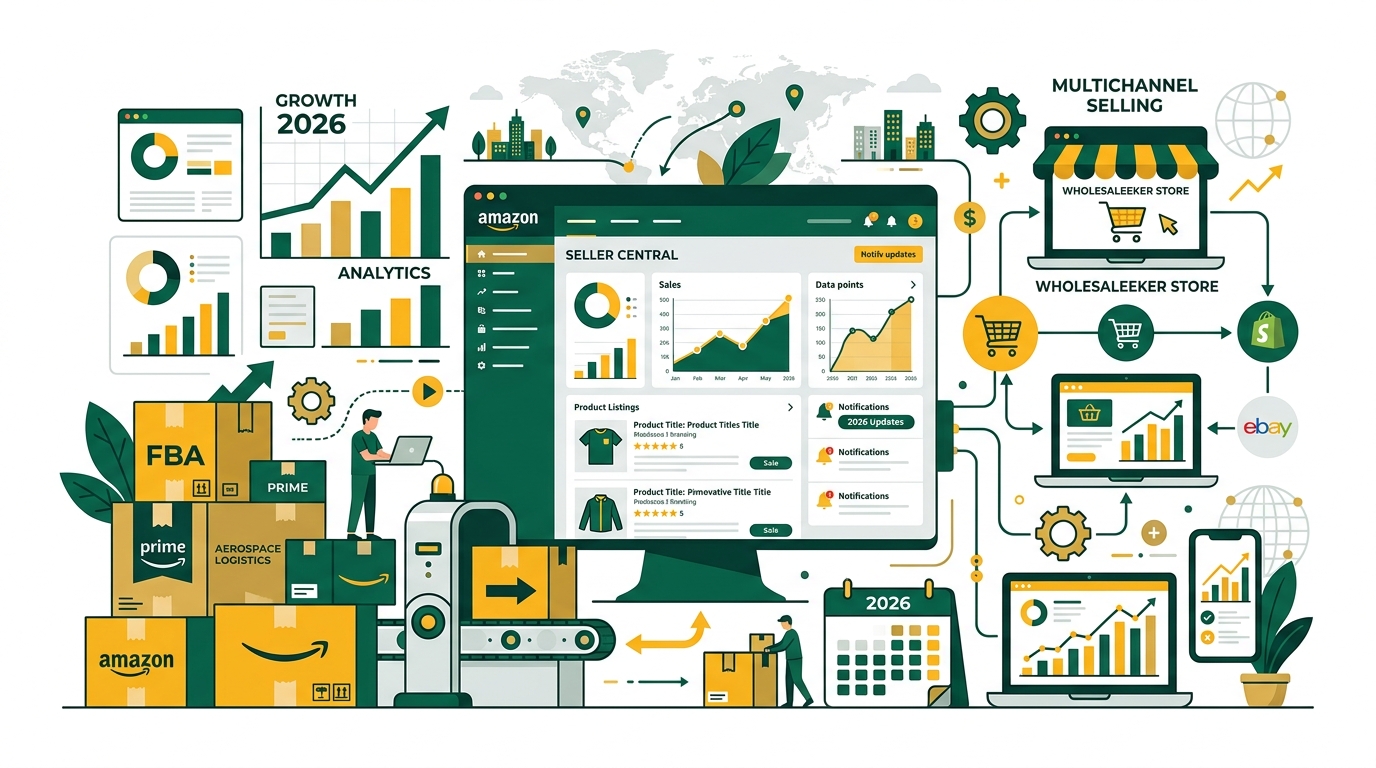
Amazon introduced a series of functional changes across Seller Central and the Amazon Ads console during fall 2026. The new features expand Seller Central into an operations console for competing retail marketplaces and integrate generative AI into listing tasks, performance analytics, and advertising management.
The following breakdown details what each update changes for day-to-day operations across wholesale and brand accounts.
1. Amazon Multichannel Selling Tools in Seller Central
Sellers can now link external storefront accounts from Walmart, eBay, Shopify, and TikTok Shop directly inside Seller Central.
The consolidated interface imports listings, coordinates catalog mapping, displays multichannel orders, and triggers warehouse fulfillment. Amazon provides the software tools at no subscription cost to U.S. sellers during a phased rollout.
Off-Amazon orders route through Multi-Channel Fulfillment (MCF) using inventory stored in Amazon fulfillment centers. Amazon also introduced a promotional MCF rate structure with fee reductions of 15% to 25% for the first six months. Future releases will add cross-platform description editors, automated listing generation for external storefronts, and SKU-level profit metrics tracking ad spend alongside sales volume.
2. Seller Assistant Adds Autonomous Workflows
Amazon updated Seller Assistant to run autonomous operational routines without continuous manual prompts.
These background workflows monitor active listings to carry out pricing adjustments, track restock thresholds, and flag catalog suppression based on preset rules. Instead of manually inspecting individual SKUs, operators configure target parameters while the system monitors and updates listings.
While automated routines reduce administrative overhead on large catalogs, flawed rule definitions can replicate pricing or inventory errors across entire product lines.
3. Amazon Connects Seller Data Directly to Claude and Amazon Quick
Amazon published official Seller Assistant integrations for Anthropic’s Claude and Amazon Quick, enabling sellers to query their Seller Central databases directly within these AI platforms.
Operators can ask specific questions regarding sales velocity, inventory aging, and advertising return in plain language. The system retrieves figures directly from live account data, eliminating the need to export and clean spreadsheet reports.
For operators using AI for analytical workflows, direct data integration streamlines routine reporting.
4. AI Dashboard for Sponsored Ads Campaigns
Amazon Ads added an automated summary interface to the Sponsored Ads management console.
The dashboard analyzes campaign performance variations and generates written summaries of weekly movements. It highlights rising cost-per-click rates, flags keywords consuming budget without delivering conversions, and suggests bid adjustments.
This automated diagnostic helps operators manage advertising accounts without dedicated agency retainers.
5. AI-Powered Tools in Custom Analytics Dashboards
Custom analytics dashboards now include natural-language processing tools for data extraction.
Operators can construct custom performance tables by typing descriptive prompts rather than assembling manual formulas or combining disjointed report files.
For brands advertising multiple product lines, this reporting clarifies customer acquisition paths and repeat purchase behaviors.
6. Amazon Introduces Review Request Ads
Review Requests present rating prompts to verified purchasers on prominent retail surfaces, including the Amazon homepage.
Shoppers can submit a star rating with a single tap or contribute written feedback with images or video clips. Amazon states early program trials produced an approximate threefold increase in weekly ratings and review volume. The ad format launches in November 2026 under Amazon’s verified-purchaser policies.
Because prompts reach only confirmed buyers, the tool provides compliant review generation without violating platform terms.
7. Amazon Ads Launches Reserve Share of Voice
Reserve Share of Voice is a Sponsored Brands purchasing option designed for branded search queries.
Brand owners can contract a fixed share of the top Sponsored Brands placement ahead of time, securing guaranteed visibility rather than bidding in real-time auctions for each shopper search query.
Securing guaranteed impression share prevents competing brands from bidding on proprietary brand names to divert purchase-ready traffic.
Need reliable inventory to sell on Amazon?
Find verified wholesale suppliers for Amazon FBA and multichannel sellers in the WholesaleSeeker directory.
Browse Wholesale SuppliersAll 7 Amazon Seller Updates at a Glance
| Update | What it does | Best for |
|---|---|---|
| Multichannel selling tools | Manage Walmart, eBay, Shopify, TikTok in Seller Central | Sellers on multiple marketplaces |
| Seller Assistant workflows | Executes pricing and inventory rules automatically | Large product catalogs |
| Claude and Amazon Quick plugin | Queries live seller data within AI assistants | Data-driven operators |
| Sponsored Ads AI dashboard | Automated performance summaries and bid suggestions | Sellers managing own PPC |
| AI custom analytics | Builds reporting tables from natural-language prompts | Brands running complex ads |
| Review Requests | Displays one-tap rating prompts to verified buyers | New ASIN launches |
| Reserve Share of Voice | Guarantees top Sponsored Brands impression share on branded terms | Registered brand owners |
- Seller Central now coordinates listings, orders, and fulfillment across Walmart, eBay, Shopify, and TikTok Shop.
- Autonomous AI workflows require precise parameter boundaries to prevent compounding repricing errors.
- Review Requests expand review generation across verified buyers starting November 2026.
- Initial feature rollouts prioritize U.S. professional selling accounts.
- Wholesale profitability depends on supplier pricing and buy box stability rather than software tools alone.
Operational Next Steps for Sellers
Implement updates gradually based on current business constraints. Operators managing multiple channels should test multichannel syncing and evaluate MCF rate cards first. Brand owners planning fourth-quarter launches can incorporate November’s Review Request ad units into their product launch schedules.
Software features simplify account maintenance, but long-term profitability remains tied to verified sourcing channels. To review reliable distributors, explore our directory of top USA wholesale suppliers for Amazon FBA sellers and our strategic guide on how to scale an Amazon FBA wholesale business.
Frequently Asked Questions
What did Amazon announce at Accelerate 2026?
Key announcements included free multichannel selling tools for managing Walmart, eBay, Shopify, and TikTok orders in Seller Central, autonomous operational workflows in Seller Assistant, and account data integrations for Claude and Amazon Quick.
Are Amazon’s multichannel selling tools free?
Yes. Amazon provides the multichannel management interface at no software cost to U.S. sellers during the initial rollout. Fulfilling off-Amazon orders through Multi-Channel Fulfillment incurs standard MCF fees, with a promotional 15% to 25% discount available for the first six months.
When do Amazon Review Requests launch?
Amazon scheduled Review Requests to launch in November 2026. The ad product displays rating prompts to verified purchasers on retail surfaces such as the Amazon homepage.
Can I connect my Amazon seller account to Claude?
Yes. Amazon published an official Seller Assistant plugin for Claude and Amazon Quick, allowing sellers to query sales, inventory, and advertising metrics directly inside those conversational tools.
What is Reserve Share of Voice on Amazon?
Reserve Share of Voice is a Sponsored Brands purchasing option that allows brand owners to secure a predetermined share of top ad impressions on branded search terms, replacing dynamic real-time auction bidding on proprietary keywords.
What are Seller Assistant autonomous workflows?
They are automated background processes in Seller Assistant that perform repetitive listing, repricing, and inventory tasks according to predefined operator rules and constraints.