What a Shoe Pallet Is
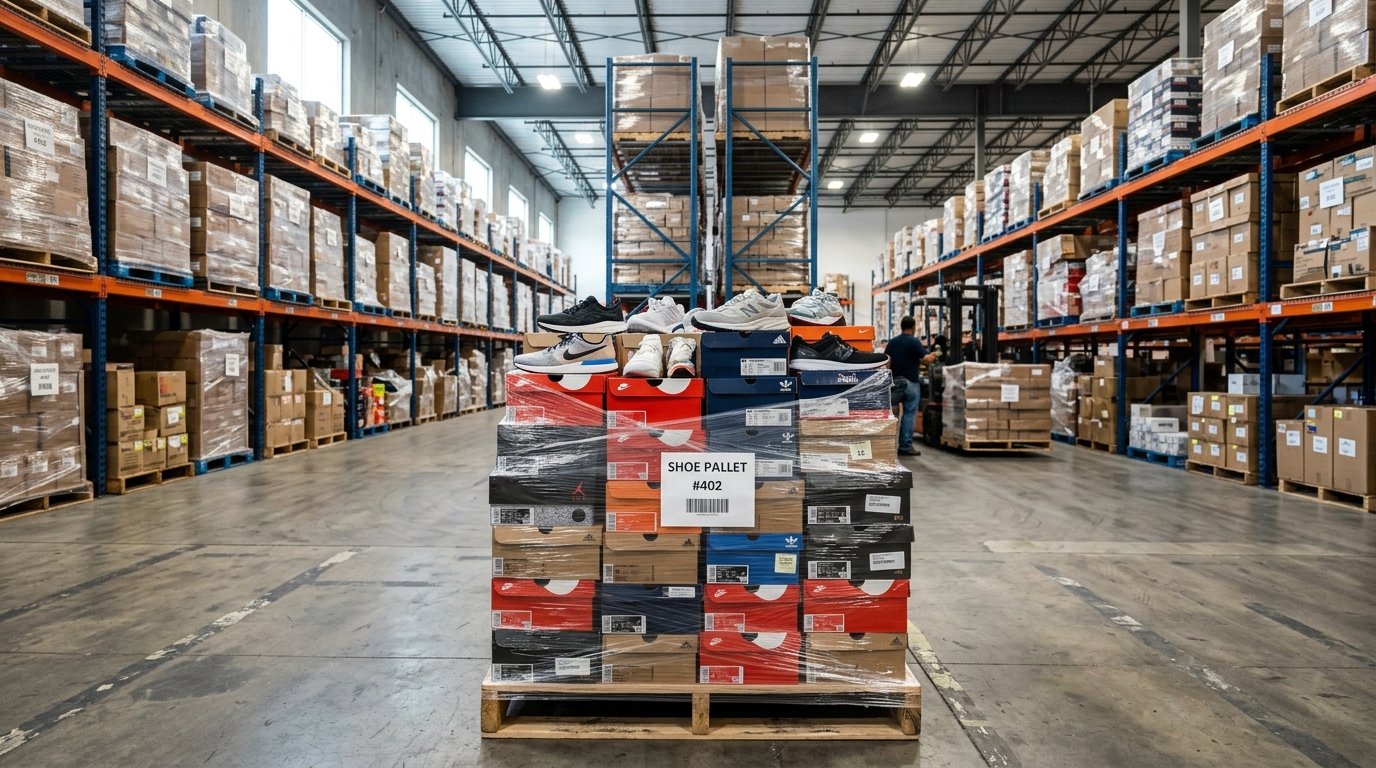
A shoe pallet is a shrink-wrapped bulk lot of footwear packed onto a standard 48×40 wooden pallet, sold individually or in full truckload quantities (typically 24 to 26 pallets). Inventory originates from department store overstock, seasonal retail clear-outs, and eCommerce customer returns.
Footwear remains a high-demand liquidation category due to rapid consumer inventory turnover. However, profitability depends on the size run. A pallet loaded with extreme or fringe sizes (such as men’s 6 or women’s 12) ties up working capital, regardless of brand prestige.
Pallet compositions range from single-category lots (such as branded athletic sneakers, women’s dress shoes, or steel-toe work boots) to mixed department loads containing assorted family footwear. Single-category manifests simplify listing workflows and allow resellers to target specific buyer demographics.
Where to Buy Shoe and Sneaker Pallets
Sourcing channels differ by purchasing model (timed auctions versus fixed-price wholesale) and minimum capital requirements.
1. Major liquidation marketplaces
Liquidation.com hosts recurring auctions for retailer-direct footwear lots, including pallet and truckload quantities. Most auctions provide downloadable manifests listing brand names, estimated retail values, and item counts.
B-Stock operates private B2B liquidation marketplaces directly for major retail chains. Store-return footwear and seasonal overstock sell via auction straight from regional retailer distribution facilities.
Direct Liquidation offers tiered footwear pallets and truckloads from major big-box chains, featuring fixed-price buy-it-now lots alongside traditional auction listings.
2. Footwear-focused and closeout liquidators
Specialist footwear liquidators and closeout houses often carry better-organized size runs than general merchandise auctions. Via Trading supplies footwear in case-pack and full-pallet quantities, permitting on-site freight inspection and warehouse pickups at their Southern California facility to eliminate line-haul freight charges.
Merkandi is an international wholesale directory listing job lots and liquidation stocks from vetted European and US distributors, useful for sourcing European sportswear and athletic sneaker overstock.
3. Regional wholesale warehouses
Footwear freight expenses scale rapidly with box volume and pallet weight. Sourcing from a facility within driving distance eliminates commercial freight charges and permits in-person manifest inspection before payment. Our directory lists regional distributors so you can source closer to home.
Find verified footwear and liquidation suppliers
Browse contact-ready shoe wholesalers and liquidation sources in the WholesaleSeeker directory.
Browse the DirectorySource Comparison Table
| Source | Format | Best for | Manifest | Typical entry |
|---|---|---|---|---|
| Liquidation.com | Timed Auction | Retailer footwear at volume | Usually | Mid to high ($1,000+) |
| B-Stock | Retailer Auction | Direct-from-retailer return streams | Varies by seller | Mid ($1,000-$2,500) |
| Direct Liquidation | Auction and Fixed Price | Big-box return streams | Yes | Mid ($800-$2,000) |
| Via Trading | Fixed and Local Pickup | Case packs and local warehouse pickup | Often | Low to mid ($500+) |
| Merkandi | B2B Marketplace | Brand-name lots and international sellers | Often | Varies by distributor |
Footwear Conditions and Grades
Liquidation grading determines necessary refurbishing hours and expected unsellable unit scrap rates:
| Grade | Physical Condition | Resale Outlook |
|---|---|---|
| Overstock / New in box | Brand-new, unworn, original packaging | Highest, sells close to retail value |
| Shelf pull | New but pulled from display, minor box wear | Strong, minor discount on secondary markets |
| Customer returns | Returned pairs, mixed condition | Good margin after sorting and inspection |
| Salvage / as-is | Worn, damaged, single shoes, or mismatched | Parts, repair, or bulk discount clearance |
When reviewing customer-return manifests, look for two persistent inventory risks: worn outsoles and missing mates. Confirm whether the manifest guarantees paired, boxed units; a pallet with single shoes or mismatched pairs carries negligible resale value.
What Shoe Pallets Cost Per Pair
Shoe pallets typically sell for a fraction of retail, and the critical metric is your net landed cost per pair. A pallet holding 200 pairs at $1,000 averages $5 per pair before freight, buyer premiums, and processing supplies.
Calculate net landed cost before bidding. Add pallet purchase price, carrier freight, and repackaging expenses, then divide by the number of inspectable, sellable pairs, accounting for unsellable salvage units. Compare that landed cost per pair against current marketplace clearing prices. Our wholesale margin and landed-cost calculators simplify this comparison.
Aim for a total landed cost per sellable pair that does not exceed 30% to 35% of your realistic resale market price. That operating margin absorbs unsellable units and platform selling fees.
- Condition dictates margin: overstock and shelf-pulls command premium resale prices, while customer returns demand hands-on inspection.
- Prioritize size runs: single-category lots with popular adult size curves turn over significantly faster than mixed odd-size lots.
- Calculate landed costs: budget freight, buyer premiums, and an expected 10% to 15% unsellable defect rate into your target purchase price.
- Freight proximity matters: footwear pallets weigh 400 to 800 lbs, so sourcing within regional driving distance preserves margins.
- Verify mates and packaging: confirm paired footwear in writing before bidding on raw customer returns.
Brand-Name Sneakers and Authenticity
Loads advertised as Nike, adidas, Jordan, or New Balance carry high resale value, alongside elevated counterfeit risk when sourced from unverified brokers. Genuine brand-name liquidation originates strictly through authorized retailer return clearinghouses, not anonymous brokers advertising flat-rate prices on social platforms.
Purchase branded athletic inventory exclusively from liquidators who provide chain-of-custody documentation or retailer source origin. Significantly depressed per-unit pricing on popular sneakers serves as an indicator of unauthorized replicas, factory defects, or stolen inventory.
How to Vet a Footwear Liquidation Supplier
Request manifests itemizing individual shoe sizes alongside brand names and unit counts. Size distribution is the critical detail unverified sellers frequently omit. Confirm condition grading and whether pairs are boxed and matched in writing before payment.
Verify that the company maintains a physical warehouse address, a working customer service phone line, and an established commercial track record. Prefer payment methods offering buyer protection. Start with a single sample pallet to evaluate grading consistency before committing larger capital. For broader sourcing guidance, review our advice on finding legitimate wholesale suppliers.
Where to Resell Liquidated Shoes
Route each pair to the channel matching its physical condition:
New and boxed pairs perform well on Amazon (for ungated sellers), eBay, Poshmark, Mercari, and dedicated sneaker platforms like GOAT. Open-box pairs with minor handling marks sell reliably through local marketplaces, flea markets, and consignment outlets. Fringe sizes and lower-grade pairs can be bundled into bulk liquidation lots for secondary resellers.
Photograph individual pairs, document outsole condition accurately, and list exact manufacturer sizing. Misrepresented condition grades cause elevated customer return rates and damage seller account health.
Glossary
- Manifest
- An itemized list of a pallet’s contents, specifying brand names, model styles, and size curves for footwear.
- Size run
- The distribution of footwear sizes in a load, representing the primary driver of inventory turnover.
- Overstock
- Brand-new, unsold inventory cleared directly by a retailer.
- Shelf pull
- New footwear removed from retail displays, typically during seasonal resets.
- Customer returns
- Footwear returned by consumers, in mixed and untested physical condition.
- Salvage
- Worn, defective, single shoes, or mismatched pairs sold as-is for parts or deep discount clearance.
- Landed cost
- The comprehensive expense of an inventory lot, including bid price, buyer premiums, freight, and prep supplies.
Frequently Asked Questions
How much do shoe pallets cost?
Shoe pallets generally cost $500 to $2,500. On a per-unit basis, buyers pay $3 to $12 per pair, with total cost determined by brand classification, packaging integrity, and condition grade.
Where can I buy sneaker pallets?
Primary sources include Liquidation.com, B-Stock, and Direct Liquidation, alongside footwear liquidators like Via Trading and B2B directories like Merkandi. For branded sneakers, buy exclusively from suppliers providing documented retailer origin.
Are shoe liquidation pallets worth it?
Shoe pallets are profitable when manifests show balanced adult size runs and low defect rates. Profit margins deteriorate when loads contain high percentages of unboxed singles, damaged outsoles, or extreme sizes.
How do I avoid fake branded sneaker pallets?
Source only through established liquidation platforms and contracted liquidators capable of demonstrating retail supply origin. Avoid anonymous suppliers advertising high-value sneakers at steep discounts without documentation.
What should a shoe pallet manifest include?
A reliable manifest specifies brand names, style numbers, condition grade, total pair counts, packaging status, and an itemized size run.
Ready to source footwear by the pallet?
Find verified shoe wholesalers and liquidation suppliers across the USA, UK, and Canada.
Browse Wholesale Shoe Suppliers