Buying wholesale inventory is an upfront capital commitment. Once you purchase 500 units, storage fees, cash flow, and obsolescence risks belong entirely to you. You can validate true retail demand before issuing a deposit by examining 5-year search patterns, analyzing marketplace velocity, inspecting competitor Shopify stores, and checking active advertising libraries.
- Marketplace popularity alone is deceptive: Confirm that demand is stable year-round rather than an expiring fad or temporary seasonal peak.
- Verify three tiers of proof: Triangulate organic search volume, marketplace review velocity, and standalone brand storefronts.
- Long-running ad campaigns indicate profitability: Competitors rarely run ads for longer than 30 days if the underlying item produces net losses.
- Use an objective checklist: Score every potential order against explicit criteria and start with modest initial runs whenever signals show mixed results.
Buying wholesale is an investment risk. Once you have paid for 500 units, you own the full operational challenge: warehousing, tied-up working capital, and the prospect of steep markdowns three months later. Most sellers who experience losses did not pick a dishonest vendor. They purchased a product that real buyers did not want in the volume ordered.
The good news is that you can evaluate consumer demand before placing an order using free tools and an afternoon of focused work. This guide walks through the exact verification steps to take in sequence, ending with a repeatable go or no-go evaluation checklist.
- Why “It Sells on Amazon” Is Not Enough
- Step 1: Check Search Interest Over Time
- Step 2: Read Marketplace Data and Review Velocity
- Step 3: Analyze Competitor Shopify Stores
- Step 4: Inspect Ad Libraries for Profitability Signals
- Step 5: Identify Saturation and Seasonality Red Flags
- Step 6: Reduce the Downside Risk on Your First Purchase
- The Go / No-Go Validation Checklist
- About the Author
Why “It Sells on Amazon” Is Not Enough
A SKU that moves rapidly for an established seller can still prove disastrous for your business. Three common issues regularly catch buyers off guard:
- Timing: You discover a product at the peak of its market popularity. Demand drops sharply just as your shipment clears customs.
- Seasonality: An item that moves quickly in November may sit completely idle on warehouse racks until the following autumn.
- Market Saturation: Twenty competing merchants offer the identical item. When listings crowd together, clearing inventory often requires triggering a price war that destroys gross margins.
Validating demand means verifying each risk factor before committing capital. None of the methods below provides a complete picture by itself. Taken together, they deliver reliable insight into real consumer buying behavior.
Step 1: Check Search Interest Over Time
Step 1
Start with Google Trends, which is free and takes two minutes to set up.
- Search for the item using natural consumer query terms (for example, “insulated dog bowl” rather than a factory part code).
- Set the timeline range to 5 years. A brief 12-month window hides multi-year declines and masks cyclical swings.
- Set the regional filter to your specific target market.
Look for a search line that remains level or climbs gradually over multiple years. Watch out for two deceptive trend patterns:
- A sudden spike within the recent two or three months: This may represent a brief viral video or temporary news cycle that disappears before your freight arrives.
- Identical repeating peaks each calendar year: This indicates an intrinsically seasonal item. Seasonal goods can still be profitable, but your delivery schedule and unit quantities must align tightly with the buying window.
Compare two or three naming variations for the same item alongside competing product types to confirm where consumer attention is heading.
Step 2: Read Marketplace Data and Review Velocity
Step 2
Marketplaces reflect real purchasing transactions rather than casual search curiosity.
Reviews and Listing Age
On Amazon, examine the highest-ranking listings. Check the total number of customer reviews, how frequently new verified reviews arrive, and how long the product detail page has existed. A consistent trickle of fresh reviews across a listing that has operated for 12 to 24 months points to steady demand. A sudden burst of reviews in a single month followed by weeks of silence serves as an early red flag.
Sales Rank and Historical Pricing
Keepa charts provide historical data on sales rank, Buy Box pricing, and competing seller counts over long intervals. A stable sales rank combined with steady pricing across six to twelve months provides reassuring proof of consistency. For deeper guidance on interpreting these charts, consult WholesaleSeeker’s tutorial on Keepa for Amazon wholesale product research.
Active Seller Density
If the number of third-party merchants selling the identical ASIN rises steadily while average prices trend downward, late arrivals face severe pressure. In overcrowded listings, margin compression always happens first.
Examine at least two channels if you distribute across multiple outlets. Velocity on Amazon does not automatically translate to eBay, TikTok Shop, or Walmart, and vice versa.
Step 3: Analyze Competitor Shopify Stores
Step 3
Marketplaces demonstrate that an item moves. Independent brand websites demonstrate whether a merchant can sell that item profitably at healthy retail margins, which is critical when funding wholesale inventory.
Search for the item on Google and catalog the independent, direct-to-consumer websites appearing in results alongside retail giants. Then evaluate four specific factors:
- Total Active Stores: Finding two or three dedicated storefronts indicates healthy, viable interest. Finding dozens of generic shops using identical supplier stock imagery signals intense commoditization.
- Price Spreads: Record the minimum, typical, and maximum retail prices across storefronts. Your total landed cost (including unit purchase, ocean or air freight, import duties, and transaction fees) must leave adequate gross profit below the typical price point, not merely the highest one.
- Sales Sorting: On many Shopify stores, appending
/collections/all?sort_by=best-sellingto the base domain displays catalog products in order of actual transaction volume. If your target item appears near the top of the collection, that confirms strong internal performance. - Store Investment Signals: Check whether the item page features recent customer feedback, user photos, bundles, or color variations. Brands consistently invest resources into product pages that generate return on investment.
To inspect independent storefronts further, read this detailed step-by-step guide to analyzing a competitor’s Shopify store, which details free methods for discovering store themes, integrated tools, and top-selling SKUs.
Step 4: Inspect Ad Libraries for Profitability Signals
Step 4
Public advertising registries offer valuable demand intelligence. They reveal exactly which items competitors pay cash to advertise, and for how long.
- Meta Ad Library: Query Facebook and Instagram by brand name or product keyword. Review the date each creative began running.
- TikTok Creative Center: Filter top-performing commercial ads by vertical to observe which SKUs receive active paid spend today.
The reasoning is simple: commercial businesses stop funding campaigns that generate ongoing losses. An advertisement that has run continuously for 30 days or longer provides compelling evidence that customer acquisition costs remain profitable. If multiple competing brands run long-standing campaigns for the same item, market demand is genuine. If you only encounter ads that ran for three to five days before shutting off, prior sellers likely tested and abandoned the SKU.
Ad presence also clarifies customer acquisition difficulty. High advertiser density means you will bid higher per click to win attention, which you must deduct from your profit margins before placing a purchase order.
Step 5: Identify Saturation and Seasonality Red Flags
Step 5
Before issuing a payment, compile your observations and look for these warning signals:
- Search interest shows a consistent multi-year downward trajectory.
- Marketplace merchant counts climb while retail price points deteriorate.
- Every competing storefront relies on unmodified factory photography and identical product descriptions.
- Paid advertising campaigns for the SKU were terminated after brief testing periods.
- Customer demand concentrates inside a narrow annual window of two to three weeks, and your production lead times risk missing that window.
A single warning signal warrants caution. Two or three simultaneous red flags indicate that you should pause and redirect your working capital elsewhere.
Step 6: Reduce the Downside Risk on Your First Purchase
Step 6
Even when research indicates strong market interest, sensible inventory buyers structure terms to limit downside exposure:
- Negotiate Smaller Opening Orders: Request a lower minimum order quantity (MOQ) on your trial shipment, even if that requires paying a slightly higher unit cost. Paying an extra dollar per unit to validate customer interest is far cheaper than liquidating stagnant pallets at a loss.
- Test Small Batches First: When suppliers support sample runs or domestic fulfillment, purchase twenty to fifty units to test actual conversion rates and shipping durability before placing container orders.
- Vet Your Supplier Thoroughly: A high-demand product sourced from an unreliable manufacturer still produces negative outcomes. Review WholesaleSeeker’s guides on avoiding fake wholesale suppliers before sending payment and reviewing warning signs of a risky vendor before transferring funds.
Once customer demand is confirmed, compare multiple vendors for the same product line. Searching a dedicated wholesale supplier directory enables you to negotiate terms, compare factory certifications, and balance lead times rather than accepting the first pricing proposal.
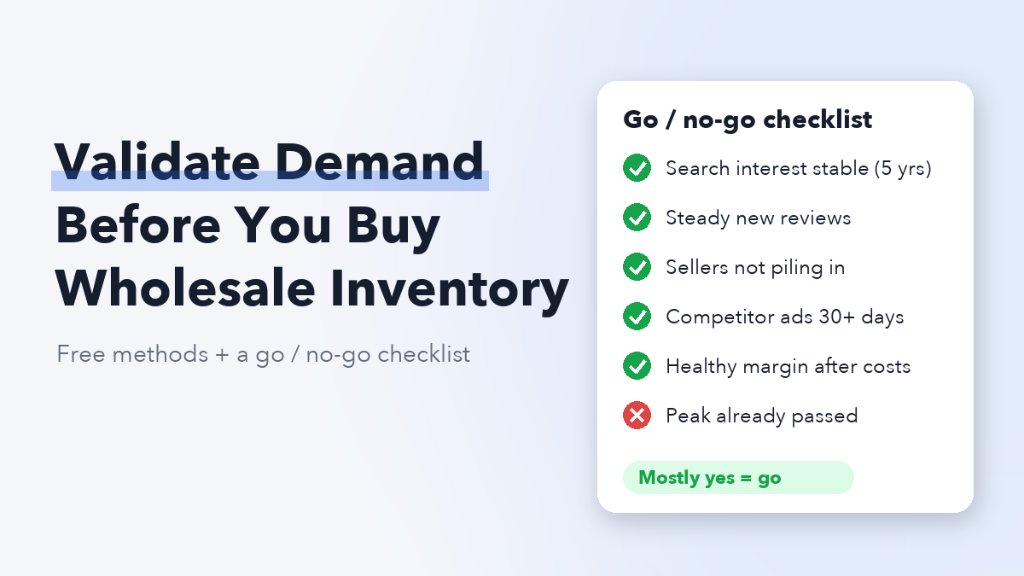
The Go / No-Go Validation Checklist
Review each question below and record a simple Yes or No before authorizing a purchase order:
How to Score Your Assessment:
- 7 to 8 Yes Answers: Clear Go. Proceed with a standard initial order.
- 5 to 6 Yes Answers: Conditional Go. Proceed cautiously with a reduced trial batch to test conversions.
- 4 or Fewer Yes Answers: No-Go. Do not place an order. Continue research or revisit the opportunity later.
Practical Next Steps for Wholesale Buyers
Validating consumer demand does not require enterprise software subscriptions or dedicated analysts. Google Trends, marketplace sales metrics, competitor storefront inspections, and public advertising registries provide the critical signals you need for free.
The retailers and ecommerce operators who protect their working capital evaluate demand before committing cash. They let a structured checklist, rather than supplier enthusiasm, make the final purchasing decision. Run these steps on your next product shortlist before requesting formal proforma invoices.
Ready to Source High-Demand Products?
Explore thousands of verified suppliers, manufacturers, and distributors across hundreds of categories.