Amazon product pages no longer convert on product information alone. Shoppers quickly compare similar listings, scan visuals before reading details, and look for proof before adding a product to their cart.
Standard descriptions help explain what the product is, but they offer limited space to build trust, show use cases, answer objections, or create a stronger brand impression. Most of the selling is left to plain text, bullet points, and images placed elsewhere on the listing.
With competing sellers on nearly every search page and shoppers able to compare products in seconds, a plain description alone simply does not cut it.
That is where Amazon A+ Content changes the equation. Amazon A+ Content gives brand-registered sellers a more conversion-focused way to present the same product. With comparison charts, lifestyle visuals, feature modules, and structured storytelling, shoppers can understand value faster and feel more confident about their purchases.
For brand-registered sellers, it shifts product pages from informational to persuasive, and the difference shows up in conversion numbers that matter. The blog ahead explores how A+ Content turns product pages into high-converting sales assets and why sellers should invest in it.
What a Standard Product Description Cannot Show a Shopper?
A standard Amazon product description gives sellers two content areas:
- A plain text block
- A list of bullet points
Neither format supports images inside the description, brand modules, comparison tools, or any layout beyond basic text. That limitation matters more today than it did several years ago, because buyer expectations on Amazon have shifted considerably.
When a shopper cannot physically examine a product, they rely on the listing to fill in what they cannot touch, feel, or see in person. For example, a bullet that says “durable materials” makes a claim, but a layered image module that shows close-up details of the materials gives a shopper evidence.
That shift from claim to visual proof can be the difference between a shopper who keeps browsing and one who feels confident enough to click Add to Cart.
Standard descriptions also offer limited flexibility for cross-selling, brand storytelling, or guiding a shopper through a structured feature description. They help communicate product information, but they rarely close the gap between understanding a product and feeling ready to buy.
How Does A+ Content Change What a Shopper Experiences on Your Product Listing?
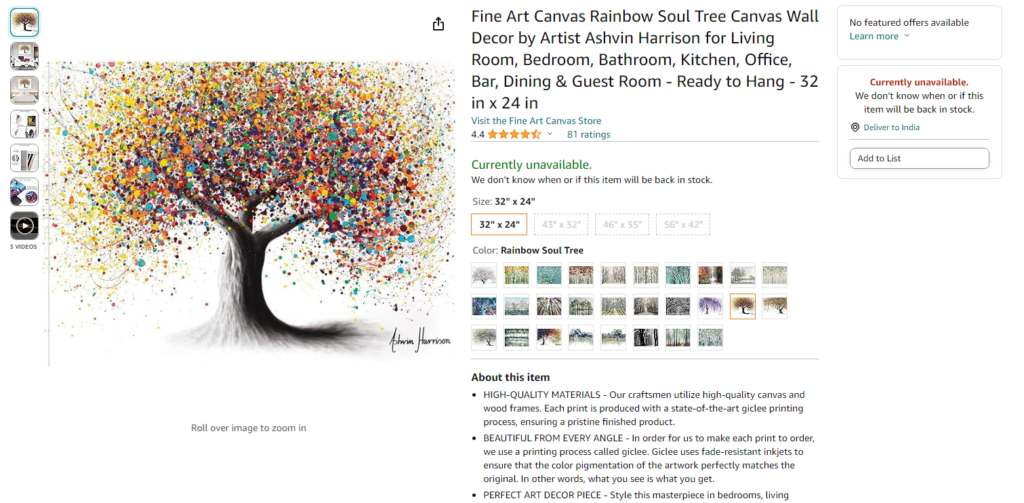
Image Source: SunTec India
A brand-registered product page using A+ modules to present color variants, lifestyle context, and product details in a single, scannable layout.
The listing above is from a real A+ Content project for a global framed art retailer. Their original product pages relied on text descriptions, giving shoppers no way to judge color accuracy, scale, or how a piece would look on an actual wall. The original text-heavy layout was replaced with structured A+ modules, which meant that the buyers could see multiple product angles, scroll through color variants, and compare size options all before reading a single description bullet. |
Amazon A+ Content gives brand-registered sellers access to structured content modules. Each one targets a specific point in the buyer’s decision process, addressing concerns that may cause shoppers to hesitate before completing a purchase.
The modules that consistently deliver results include:
- Lifestyle image with text overlay: Places the product in a real-world setting so shoppers understand scale and context without having to guess.
- Brand story section: Builds credibility and communicates the reasoning behind the product line in a format that plain bullet points cannot replicate.
- Feature icons with short descriptions: Presents key selling points in a scannable visual format that works equally well on desktop and mobile.
- Comparison chart: Lets shoppers evaluate variants or related products without leaving the current listing page.
- Related product modules: Keeps buyers within the brand catalog instead of sending them back to Amazon search results.
Each module answers a question that could otherwise slow the buying decision. When those questions are resolved within the listing itself, shoppers have fewer reasons to leave and compare elsewhere.
Amazon A+ Content vs Standard Description: What Each Format Gives Shoppers
For sellers weighing whether to invest in enhanced content, the table below shows where the gap between formats is most significant:
| Feature | Standard Description | Amazon A+ Content |
| Product imagery | Main images only | Lifestyle, comparative, and contextual visuals |
| Brand storytelling | Not supported | Dedicated brand story module |
| Variant comparison | Not available | Built-in comparison chart modules |
| Feature presentation | Text bullets | Visual icons with descriptive text modules |
| Mobile layout | Basic text format | Modular, mobile-responsive design |
| Cross-sell support | Limited | Related product display modules |
| Buyer guidance | Passive | Active: each module advances the purchase decision |
The Amazon A+ Content Conversion Rate Lift Is Real
Amazon reports that adding basic A+ Content to a listing can increase sales by up to 8% on average. That makes them a practical starting point before sellers invest in Premium A+ modules or more advanced visual assets.
The Amazon A+ Content conversion rate improvement comes from behavior changes at three specific points in the buyer journey. Understanding each one helps sellers prioritize which modules to build first.
- Mobile browsing: More than half of Amazon searches now happen on mobile devices, and text-heavy listings lose shoppers quickly on smaller screens. A+ Content’s modular layout holds attention longer and makes it easier to scan and understand product information without scrolling through dense blocks of plain copy.
- Variant selection: Comparison charts make product selection easier for shoppers choosing between sizes, colors, or product lines. When shoppers can compare options within the same listing, they are less likely to leave, open multiple tabs, or delay the purchase.
- Credibility: When a listing shows consistent brand photography, a clear value statement, and a polished overall layout, it signals that the seller operates as a serious brand. In categories where two competing products are priced nearly the same, perceived professionalism can influence the purchase decision.
What Sellers Often Miss About the Long-Term Value of A+ Content?
Amazon A+ Content benefits are often measured through conversion rate lift, but that is only one part of the value it offers. Well-built A+ modules also help achieve:
- Lower return rates: Detail-rich modules that show scale, materials, and real-use scenarios give shoppers a clearer picture before buying, reducing returns driven by mismatched expectations.
- Fewer Q&A entries: Comparison charts and feature breakdowns answer questions that would otherwise pile up in the Q&A section, reducing repetitive customer queries.
- Higher catalog engagement: Cross-sell modules help keep the buyers browsing within a brand’s product range instead of returning to Amazon search results after viewing a single product.
- Better repeat purchase behavior: A brand story module that communicates a company’s values and product philosophy builds recognition that carries across shopping sessions and future purchase decisions.
Sellers building on these gains are also looking at AI optimization as a logical next step. If that is on your radar, this ranked overview of AI CRO tools for eCommerce in 2026 is worth a look.
The Elements That Make A+ Content Convert, Not Just Look Good
Not all A+ Content performs equally. A layout filled with generic stock images and copy that repeats the bullet points rarely improves how shoppers evaluate a product. Effective A+ content is centered on buyer intent: starting with the questions and objections a shopper arrives with, then selecting modules that address each one specifically.
The listings that perform consistently share three qualities:
- Original lifestyle photography that places the product in a specific, recognizable setting instead of a vaguely styled background.
- Comparison charts are used as actual decision guides instead of another way to list features, showing shoppers clearly which variant fits their situation.
- Having a module copy that is short and specific because buyers scanning on mobile will not read a dense block of content.
For brands managing multiple SKUs or launching new product lines, maintaining catalog-wide consistency is difficult. Here, an Amazon A+ Content agency can align visuals, messaging, and module selection across different product types, price points, and buyer personas.
Brands that also need strong product messaging often rely on Amazon A+ Content writing services to turn features, use cases, and buyer concerns into concise module copy that supports conversion.
Conclusion
Standard product descriptions can explain a product, but they rarely give shoppers the full context they need to buy with confidence. A+ Content adds that missing layer through visuals, comparison modules, brand messaging, and structured product storytelling.
Each module on a well-built A+ listing serves a shopper at a different stage, from first impression through final comparison before adding to cart.
For brand-registered sellers in competitive categories, A+ Content is not just a design upgrade. It is a conversion asset that continues to support product visibility, buyer confidence, and purchase decisions as competition increases.