

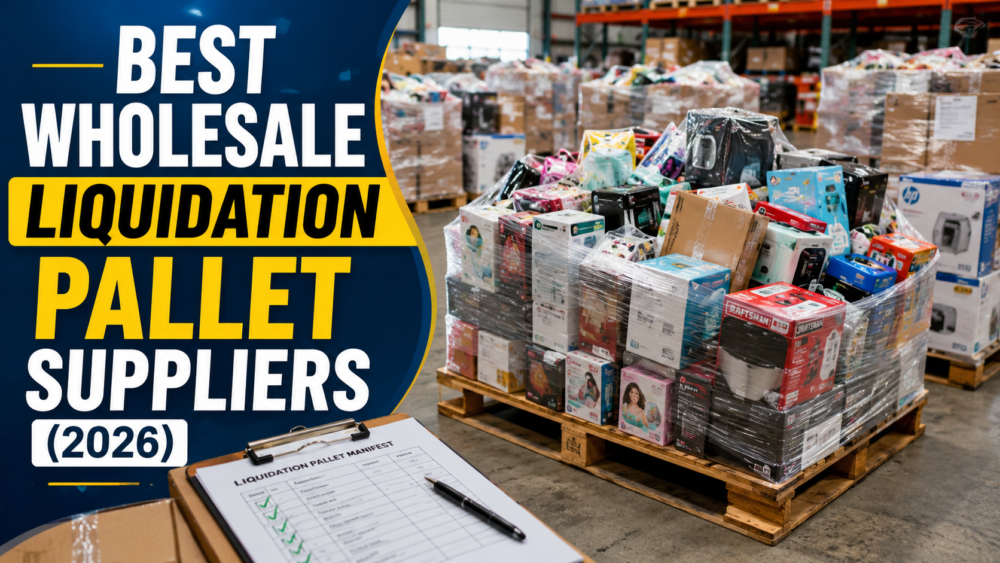
The US liquidation market has grown into a secondary economy worth hundreds of billions of dollars, and wholesale liquidation pallets sit right at the center of it. For resellers, bin store owners, flea market vendors, and Amazon and eBay sellers, buying returned and overstock merchandise by the pallet is one of the lowest-cost ways to fill inventory. But the space is also crowded with middlemen and outright scams, so knowing exactly which suppliers are legitimate matters more than anything else.
Quick Answer
The best wholesale liquidation pallet suppliers in 2026 are the retailer-direct auction marketplaces and established B2B liquidators: B-Stock (official auctions for Amazon, Walmart, Target and more), Liquidation.com, Direct Liquidation, BULQ, 888 Lots, and Quicklotz, plus regional warehouses like American Liquidations and Select Liquidation for truckloads. Buy only from platforms that require a resale certificate, provide a manifest and condition grade, and ship by freight. Expect to pay roughly $200 to $2,000 per pallet, with winning auction bids usually landing at 10 to 25 percent of stated retail value. Avoid any “$99 pallet” offered through social media ads, those are the classic scam.
What this guide covers
- What wholesale liquidation pallets actually are
- The best wholesale liquidation pallet suppliers in 2026
- Supplier comparison table
- Types of pallets: returns, overstock, shelf pulls, salvage
- Condition grades explained
- How to read a manifest (and why it matters)
- What liquidation pallets really cost
- How much you can actually make
- How to buy your first pallet, step by step
- Which retailer should you source from?
- Best product categories for beginners
- Where to resell liquidation pallets
- How to spot liquidation scams
- Frequently asked questions
Key terms, quick glossary
- Manifest
- A spreadsheet listing every item on a pallet with its retail price and UPC or ASIN. Manifested pallets are lower risk than “blind” ones.
- Condition grade
- A label (Grade A, B, C, Salvage) describing the average state of items in a lot.
- Buyer’s premium
- An auction fee, usually 10 to 15 percent, added on top of your winning bid.
- Cost per unit
- The true cost of each item: (winning bid + premium + freight) divided by the number of units.
- Truckload
- A full freight shipment of many pallets, the cheapest per-unit option but the highest total spend.
- Resale certificate
- A state tax document proving you are a business reselling goods. Required by every legitimate liquidation platform.
What wholesale liquidation pallets actually are
A wholesale liquidation pallet is a bulk lot of merchandise that a major retailer no longer wants to keep in its normal supply chain. When customers return items, when seasonal stock does not sell, when packaging gets damaged, or when a product line is discontinued, the retailer is left with inventory that is expensive to store and process. Rather than destroy it, retailers sell it in bulk to liquidation companies and resellers at a steep discount, often just 5 to 20 percent of the original retail value.
These goods get bundled onto pallets, sometimes hundreds of items at a time, and sold to businesses who then sort, test, clean, and resell the individual products. The buyers range from full-time Amazon and eBay sellers to bin store operators, flea market vendors, discount shops, and online arbitrage sellers. The appeal is simple: your inventory cost per item can be a fraction of wholesale, which leaves room for healthy margins even after some of the pallet turns out to be unsellable.
The market behind this is enormous. Industry reporting puts the US secondary market (returns and resale) well into the hundreds of billions of dollars, and it keeps growing as online shopping drives ever-higher return volumes. That growth is exactly why so many new suppliers, and so many scams, have appeared. The rest of this guide focuses on separating the legitimate wholesale liquidation pallet suppliers from the rest.
The best wholesale liquidation pallet suppliers in 2026
The suppliers below are the ones that consistently show up as legitimate, established, and buyer-verified. They fall into two groups: retailer-direct auction marketplaces (where inventory comes straight from the retailer) and B2B liquidators (companies that buy in bulk and resell to you). Both can be good; the difference is price, transparency, and how much risk you take on.
1. B-Stock, the retailer-direct auction leader
B-Stock is the largest B2B liquidation marketplace and the closest thing to buying direct. It runs the official auction storefronts for major retailers including Amazon, Walmart, Target, Best Buy, and Home Depot, each retailer has its own dedicated auction site under the B-Stock umbrella. Because the inventory comes straight from the retailer’s distribution centers, there is no middleman markup, and lots are typically manifested at the item level so you can see what is inside before you bid.
The trade-offs: you must register and pass a business verification step (including a resale certificate) before you can bid, which can take a few business days. Auctions are competitive, especially for electronics, and prices can climb. Winning bids commonly land between 10 and 25 percent of stated retail value depending on category and condition. B-Stock is best for serious, verified resellers rather than casual first-time buyers, but it is where the best-quality inventory moves.
2. Liquidation.com, one of the oldest and largest marketplaces
Operated by Liquidity Services, Liquidation.com is one of the oldest and largest online liquidation marketplaces in North America. It handles everything from retail returns to overstock and even government surplus, sourcing pallets from Amazon, Walmart, Target, and other major retailers. The platform offers auctions, fixed-price lots, and negotiated deals across a wide range of categories and condition grades, which makes it a flexible option for buyers who want variety and volume in one place.
3. Direct Liquidation, manifested pallets from major retailers
Direct Liquidation is a B2B marketplace that sources customer returns and overstock directly from Amazon and other major retailers. Its standout feature is manifested pallets: you can see exactly what items are included before you purchase, which sharply reduces the guesswork. That transparency makes it a strong pick for resellers who want to calculate expected margins against Amazon or eBay fees before committing.
4. BULQ, best for smaller, predictable lots
BULQ focuses on smaller resellers with lower buy-in. It offers manifested liquidation pallets and cases, primarily in general merchandise and home goods, with flat-rate shipping on smaller lots that makes total cost calculation straightforward. If you want predictability and a manageable first order rather than a full truckload, BULQ is one of the easiest on-ramps into liquidation.
5. 888 Lots, itemized manifests with profit tools
888 Lots is a prominent B2B liquidation supplier offering 100 percent itemized, manifested inventory lots of brand-new overstock and customer returns. It stands out for building profit-calculation tools aimed at Amazon and eBay sellers, so you can estimate returns on a lot before you buy. For data-driven resellers who live by the numbers, that tooling is a real advantage.
6. Quicklotz, decades of experience and international shipping
Quicklotz is a long-established liquidation company with decades of experience in the business. It sells pallets, cases, and truckloads, and notably ships internationally, which makes it one of the better options for buyers located outside the United States who still want access to US retailer liquidation inventory.
7. Select Liquidation, direct-ship truckloads
Select Liquidation operates a direct-ship model, sourcing truckloads straight from major retailer distribution centers. With around a decade of experience, hundreds of millions of dollars in liquidated inventory moved, and a large customer base, it is geared toward buyers ready to purchase at truckload scale rather than single pallets. It is often cited for Amazon “trophy mediums,” medium-sized items in good condition from returns.
8. Regional warehouses and bin-store suppliers
Beyond the national platforms, many buyers prefer regional warehouses they can physically visit. American Liquidations, for example, operates a Connecticut warehouse open seven days a week where you can inspect pallets in person before buying, and it lets beginners buy a single pallet rather than a full truck. Physical warehouses reduce the “mystery” risk because you can see the merchandise, though selection depends on what is in stock locally. GRP Liquidations and USA Pallet Liquidators are other examples supplying pallets, lots, and truckloads sourced from national retail networks.
Supplier comparison at a glance
| Supplier | Model | Best for | Manifest | Retailer sources |
|---|---|---|---|---|
| B-Stock | Retailer-direct auctions | Serious resellers, best inventory | Usually yes | Amazon, Walmart, Target, Best Buy, Home Depot |
| Liquidation.com | Auctions + fixed price | Variety and volume | Varies by lot | Amazon, Walmart, Target, others |
| Direct Liquidation | B2B marketplace | Transparency (manifested) | Yes | Amazon and major retailers |
| BULQ | Fixed-price lots | Smaller, predictable buys | Yes | General merchandise, home goods |
| 888 Lots | B2B, itemized lots | Data-driven Amazon/eBay sellers | Yes (100% itemized) | Overstock and returns |
| Quicklotz | Pallets to truckloads | International buyers | Varies | Major US retailers |
| Select Liquidation | Direct-ship truckloads | Truckload-scale buyers | Varies | Retailer distribution centers |
| Regional warehouses | In-person + pallet sales | Beginners, single pallets | Often in person | Target, Amazon, mixed |
Availability, warehouse locations, and lot pricing change frequently. Always confirm current terms, sources, and shipping on each supplier’s own site before buying.
Types of pallets: returns, overstock, shelf pulls, salvage
Not all liquidation pallets are the same, and the type largely determines what condition to expect. Understanding these categories is the single biggest factor in whether a pallet is a good buy.
Customer returns
Items customers sent back for any reason. This is the most common and the most variable category. A meaningful share, often roughly a third, are genuinely like-new (wrong size, changed mind, buyer’s remorse). Another share shows real wear or is missing minor components, and some items are damaged or non-functional. Returns can be very profitable, but only if you can grade and test them.
Overstock and shelf pulls
Products that were never sold to a customer, they are simply excess inventory, discontinued lines, or seasonal items pulled from shelves. These are the most desirable lots because condition is usually much closer to new. When you can find manifested overstock in a category you understand, it is often the safest liquidation buy.
Salvage
Damaged or “parts only” merchandise sold at the lowest prices. Salvage is strictly for buyers with repair skills or a parts-resale operation. If you are new, avoid salvage lots entirely until you know what you are doing.
Condition grades explained
Most liquidation platforms use standard condition grades. Knowing what each means is essential to calculating realistic margins, because the grade tells you roughly how much of a pallet you can expect to sell.
| Grade | Typical meaning | Expected sellable rate |
|---|---|---|
| Grade A | Like-new or new, minimal issues | High |
| Grade B | Good, may have minor cosmetic wear or missing minor parts | Good |
| Grade C | Noticeable wear or damage, more work to resell | Lower |
| Salvage | Damaged, parts only | Minimal (parts value) |
One crucial reality: grades describe the average of a lot, not every item. Even a pallet labeled with a single condition grade will contain a spread. A “customer returns” pallet can hold a brand-new item in one box and a used, incomplete one in the next. Experienced buyers assume that 10 to 20 percent of items are in worse condition than the manifest states, and they factor that into every purchase.
How to read a manifest (and why it matters)
A manifest is the spreadsheet that lists every item on a pallet, its stated condition, its original retail price (usually MSRP), and its UPC or ASIN. On the best platforms, lots are manifested at the item level, and the manifest is the most important document you will read before buying.
Here is how to use it properly:
- Read the manifest, not the headline retail value. The big “retail value” number on a listing is the sum of MSRP stickers, not what the items will actually resell for. Ignore it as a profit signal.
- Check the condition grade against the category. A Grade B home-goods pallet behaves very differently from a Grade B electronics pallet, where missing cords and accessories are common.
- Look up real resale prices for the higher-value items on the manifest (on Amazon, eBay, or with a tool like Keepa) before you bid. A few strong items often carry the whole pallet.
- Budget for missing parts. Kitchen and appliance lots frequently arrive missing power cords or mounting hardware. Add a few dollars per item for replacement parts in those categories before calculating margin.
- Be skeptical of unmanifested “Amazon returns.” Pallets advertised as Amazon returns away from the original marketplaces are often unmanifested, meaning you are buying a category and a grade, not a known list of items.
What liquidation pallets really cost
Pricing varies widely by category, condition, and how you buy, but here is a grounded picture for 2026:
- Single pallets typically run $200 to $2,000 before freight, containing anywhere from 100 to 500 items. Entry-level pallets at some warehouses start around $300.
- Category matters. Mixed apparel or soft-goods pallets may sell for around $400, while high-demand electronics or power-tool lots can command $1,500 to $2,900.
- Auction wins commonly land at 10 to 25 percent of stated retail value, with a buyer’s premium of roughly 10 to 15 percent added on top.
- Freight is separate and significant. Pallets ship by freight, not parcel, so always add shipping to your cost before deciding whether a lot is worth it.
- Truckloads are the cheapest per unit but the highest total spend, only sensible once you have storage, sorting capacity, and experience.
The honest way to size any lot is cost per unit: (winning bid + buyer’s premium + freight) divided by the number of units. That single number, not the headline retail value, tells you whether a pallet can be profitable.
How much you can actually make
Liquidation marketing loves headlines like “turn $2,500 into $8,000.” Those numbers are real but represent the high end. A more grounded picture, drawn from experienced resellers, looks like this:
- A well-selected, manifested Grade B pallet in toys or home goods can return roughly 2.5x to 3x cost over three to four months.
- A blind return pallet in electronics or clothing might return only 1x to 1.5x, barely breaking even after fees and unsellable shrinkage.
- Average experienced sellers see about 2x to 2.5x on their liquidation sourcing over time.
The key variable is your evaluation process, not luck. Two rules protect your margin. First, budget 15 to 20 percent of every pallet as write-offs (dead stock that will not sell at a profit). Resellers who plan for this do not panic when they hit it; those who do not often quit after one bad pallet. Second, count every cost: shipping, storage, marketplace fees, replacement parts, and your own time all eat into the spread.
How to buy your first pallet, step by step
Condensed to its essentials, here is the process that protects a first-time buyer:
- Get your paperwork ready. You will need a business entity and a state resale certificate (and a tax ID). Every legitimate platform requires these, and it can take a few business days to get verified on marketplaces like B-Stock.
- Pick a category you understand. Do not buy electronics if you cannot test them. Stick to categories where you can judge condition and know resale prices.
- Choose a manifested lot. For your first buy, prioritize suppliers that provide a manifest and a stated condition grade over blind mystery boxes.
- Do the cost-per-unit math. Add the bid (or price), buyer’s premium, and freight, then divide by units. Compare that to realistic resale prices, not MSRP.
- Set a maximum bid and hold it. On auctions, decide your ceiling from the math and do not chase a lot past it.
- Start small. Buy a single pallet before a truckload. The first pallet is where you learn to grade condition, and that lesson is far cheaper on a small buy.
- Sort, test, and list. When it arrives, grade each item, test what needs testing, and list the winners first. Recover parts or bundle low-value items rather than trashing them.
How to spot liquidation scams
The liquidation space attracts scammers because beginners often cannot tell a real supplier from a fake one. These red flags separate the two:
- The “$99 pallet” ad on social media. Legitimate pallets of real branded merchandise almost never sell for $99, and real suppliers do not advertise through Facebook, TikTok, or Instagram DM ads. Treat cheap social-media pallet offers as scams by default.
- No resale certificate required. Every legitimate platform requires business registration and a resale certificate. If a “supplier” will sell to anyone with no paperwork, be very cautious.
- No manifest and no condition grade. Real suppliers provide at least a category and a stated grade, and the best provide item-level manifests. “Trust me, it is full of high-value items” is not a manifest.
- Payment by untraceable methods. Requests for wire transfers, gift cards, or peer-to-peer cash apps to a personal account are classic scam signals.
- Prices that are too good to be true. If the math implies you are buying premium electronics for pennies, assume there is a catch.
The single rule that protects you: buy from the original liquidation marketplace or an established B2B liquidator, insist on a manifest and a stated condition grade, and be skeptical of any “Amazon pallet” offered without either.
Which retailer should you source from?
Most pallets trace back to one of a handful of major retailers, and each has a different profile. Knowing the differences helps you pick lots that match your skills and resale channel.
Amazon liquidation pallets
Amazon’s return pipeline is huge and spans thousands of categories, which means both opportunity and variability. Some Amazon warehouse lots offer clean manifests, but a significant portion of the customer-return stream is sold unmanifested or semi-manifested, so you may be bidding on a broad description like “small electronics” and an estimated item count. The upside is volume and the occasional high-value brand item; the risk is a wider range of outcomes. Amazon lots suit resellers comfortable grading returns and using tools like Keepa to check resale value.
Walmart liquidation pallets
Walmart’s lots are grounded in big-box retail: recognizable household brands, appliances, automotive goods, tools, and large patio or seasonal items. Because Walmart has direct relationships with major manufacturers, its pallets tend to include products consumers actually want, and lots often clear through official auction channels with clearer manifests and higher retail values. Walmart pallets can be heavier and bulkier, so factor freight and handling into your math.
Target, Home Depot, and other retailers
Target lots skew toward home goods, apparel, toys, and seasonal merchandise. Home Depot and Lowe’s lots lean into tools, hardware, and home improvement, which can be lucrative if you know that category. Each of these retailers sells through B-Stock’s dedicated auction sites, so you apply to each retailer’s marketplace separately.
Best product categories for beginners
The category you choose matters as much as the supplier. New buyers do best in categories that are easy to grade, cheap to ship, and simple to resell:
- General merchandise and home goods: forgiving to grade, broad demand, and less prone to the missing-accessory problems that plague electronics. A common starting point.
- Toys and games: strong seasonal demand, easy to inspect, and popular in manifested Grade B lots.
- Apparel, shoes, and accessories: low per-item shipping weight and steady resale demand, though you will sort through a range of conditions.
- Tools and hardware: higher value and durable, good if you understand the products and can test them.
Categories to approach with caution as a beginner include electronics (frequently missing cords and accessories, and harder to test) and salvage lots (parts only). The golden rule is simple: buy what you can grade, test, and price. If you cannot confidently judge an item’s condition and resale value, that is not your category yet.
Where to resell liquidation pallets
Buying well is only half the business; you also need a channel to sell through. The common outlets each suit different pallet types:
- Amazon and eBay: best for higher-value, brand-name, individually listed items where you can capture close to resale value. Watch marketplace fees when calculating margin.
- Facebook Marketplace and local pickup: ideal for bulky items (furniture, appliances) where shipping would kill the margin.
- Bin stores and discount shops: a fast way to move large volumes of lower-value mixed goods at a flat price point.
- Flea markets and pop-ups: good for clearing the long tail of a pallet, the items not worth listing individually online.
Most successful resellers use more than one channel: they cherry-pick the highest-value items for Amazon or eBay, sell bulky goods locally, and clear the remainder in bulk. Planning your resale channel before you buy is what turns a pallet from a gamble into a repeatable business.
Key takeaways
- The best wholesale liquidation pallet suppliers in 2026 are retailer-direct auction marketplaces (B-Stock, Liquidation.com, Direct Liquidation) and established B2B liquidators (BULQ, 888 Lots, Quicklotz, Select Liquidation), plus regional warehouses for in-person buying.
- B-Stock is the closest thing to buying direct from Amazon, Walmart, and Target, but it requires business verification and a resale certificate.
- Always buy from suppliers that provide a manifest and condition grade. Avoid unmanifested “mystery” pallets until you are experienced.
- Expect to pay roughly $200 to $2,000 per pallet, with auction wins around 10 to 25 percent of stated retail value plus a buyer’s premium and freight.
- Judge lots by cost per unit and realistic resale prices, never by the headline MSRP retail value.
- Budget 15 to 20 percent of every pallet as unsellable write-offs, and count all costs (shipping, storage, fees, time).
- Experienced sellers average about 2x to 2.5x return over time; the high-end “turn $2,500 into $8,000” numbers are the exception, not the rule.
- Never buy a “$99 pallet” from a social media ad. Real suppliers require paperwork and ship by freight.
Find verified wholesale suppliers, not mystery pallets
WholesaleSeeker lists verified wholesale distributors and suppliers across the USA, UK, and Canada, with direct contact details and no middleman.
Browse Wholesale SuppliersFrequently asked questions
Where can I buy Amazon liquidation pallets directly?
How much does a liquidation pallet cost?
Do I need a business license or resale certificate to buy pallets?
Are liquidation pallets profitable?
What is a manifest and why does it matter?
How do I avoid liquidation pallet scams?
Should I buy a single pallet or a truckload to start?
This guide is for general informational purposes. Liquidation inventory, supplier terms, and pricing change frequently, and reselling carries real financial risk. Always verify current terms directly with each supplier and do your own margin calculations before buying.





2 Comments
Pingback: Top 20 USA Wholesale Suppliers for Amazon FBA Sellers - Wholesale Seeker Blog
Pingback: Best Wholesale Vape & Smoke Shop Distributors USA (2026)