

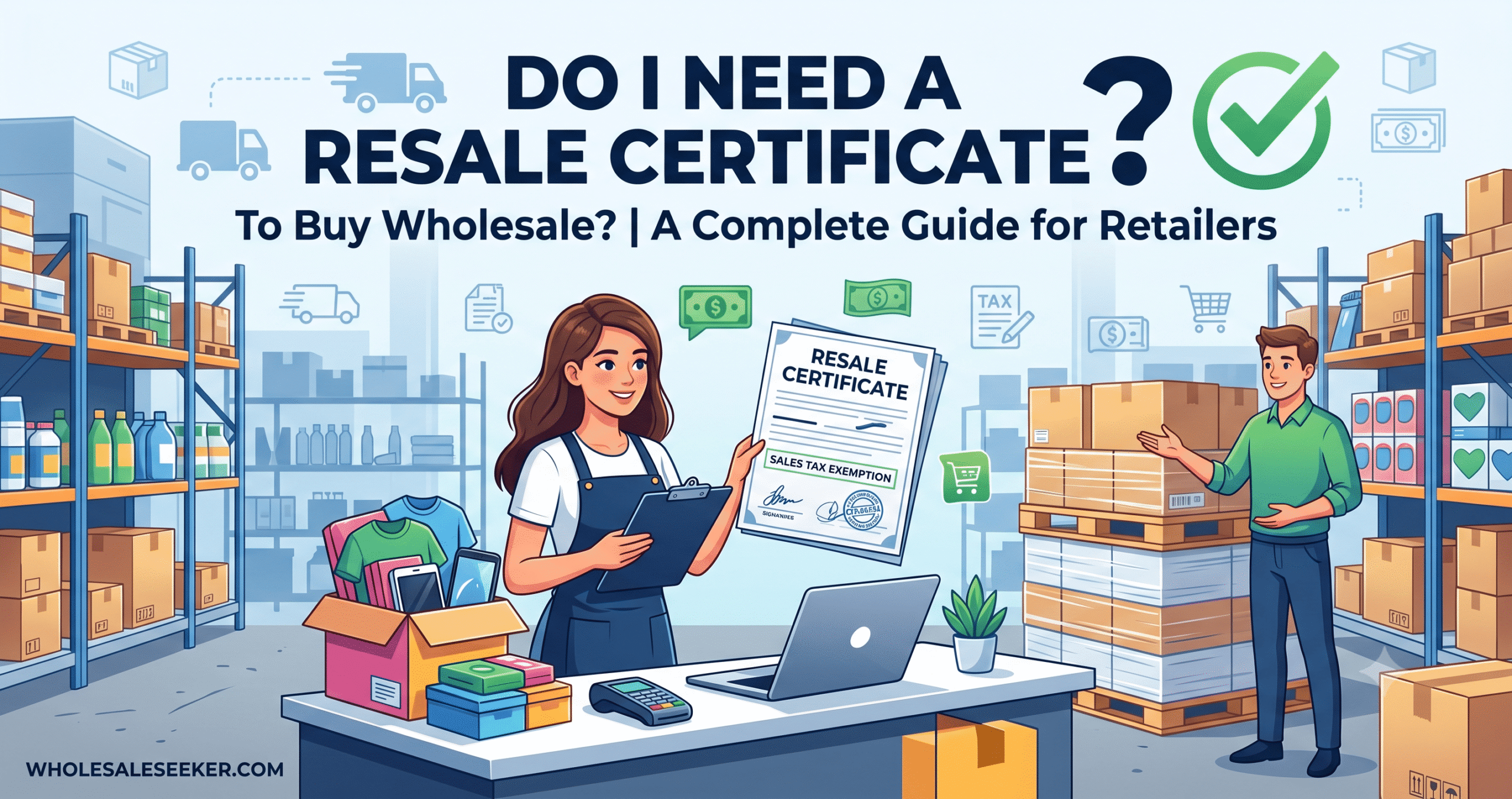
Do I Need a Resale Certificate to Buy Wholesale?
The complete 2026 answer for Amazon, Shopify, eBay & dropshipping sellers in the USA: when you legally need a resale certificate, when you don’t, how to get one free, and the 13 states that won’t accept an out-of-state certificate.
⚡ Quick Answer
In most cases, yes. If you are buying wholesale inventory to resell in the United States, the vast majority of wholesalers and distributors will require a valid resale certificate (also called a reseller’s permit or sales tax exemption certificate) before they sell to you tax-free. The main exceptions are the five states with no sales tax, international buyers, and anyone buying goods for personal use rather than resale.
📋 What This Guide Covers
- The direct answer
- What a resale certificate is
- Resale certificate vs. seller’s permit vs. wholesale license
- When you DO need one
- When you DON’T need one
- How to get one (step by step)
- The 13 states that reject out-of-state certificates
- Using it on Amazon, Shopify & dropshipping
- Costly mistakes & penalties
- Fast answers to the top questions
- Frequently asked questions
Resale Certificate at a Glance (2026)
The Direct Answer: Yes, You Almost Always Need One
If you plan to buy products in bulk and resell them, whether on Amazon, Shopify, eBay, at a physical store, or through dropshipping, then a resale certificate is one of the first pieces of paperwork you will be asked for. The reason is simple: legitimate wholesalers and distributors do not want to sell to random consumers pretending to be businesses, and they are legally responsible for the sales tax they don’t collect. Your resale certificate is the document that protects them and unlocks true wholesale pricing for you.
Here is the core logic behind the entire system. Sales tax in the U.S. is designed to be paid once, by the final consumer, at the point of retail sale. When you buy inventory to resell, you are not the final consumer. Your customer is. So the state allows you to buy that inventory tax-free, on the condition that you collect and remit sales tax when you eventually sell it. The resale certificate is your written promise to the supplier (and the state) that you will do exactly that.
Without one, two things happen. First, many serious suppliers simply won’t open a wholesale account for you at all. Second, the suppliers who will sell to you will charge you sales tax on every purchase, which destroys your margins, because you’ll effectively be taxed on inventory and then have to collect tax again from your customer. That double taxation is exactly what the certificate exists to prevent.
What Exactly Is a Resale Certificate?
A resale certificate is an official document that identifies you as a legal reseller and lets you buy inventory for resale without paying sales tax at the point of purchase. It tells your supplier: “Don’t charge me tax on this, I’m going to resell it, and I’ll collect the tax from my own customer.” The supplier keeps a copy of your certificate on file as proof of why they didn’t collect tax, which protects them if the state ever audits them.
One of the most confusing things for new sellers is that this single document goes by many different names depending on the state and the person you’re talking to. All of the following typically refer to the same underlying concept:
- Resale certificate (the most common national term)
- Reseller’s permit or reseller’s license
- Sales tax exemption certificate
- Resale license or “wholesale license” (informal)
- Certificate of resale (e.g., Illinois Form CRT-61)
When a supplier’s onboarding form asks for your “reseller’s permit,” “resale tax ID,” or “wholesale license,” they are almost always asking for the same thing: proof that you’re registered with your state to collect sales tax, and a signed certificate stating your purchases are for resale. If you’d like a deeper walkthrough of preparing to buy from suppliers, our guide on how to buy wholesale supplies for your Shopify store covers the full onboarding flow.
Resale Certificate vs. Seller’s Permit vs. Business License
These three terms get mixed up constantly, and the confusion causes real problems. Sellers apply for the wrong document, get rejected by suppliers, or assume they’re covered when they’re not. Here’s how they actually differ.
🧾 Sales Tax Permit
Your registration with the state’s tax authority that authorizes you to collect sales tax from customers. Called a “Seller’s Permit” in California, a “Sales Tax Permit” in Texas, and a “Certificate of Authority” in New York. This usually comes first.
📄 Resale Certificate
The document you hand to suppliers so they don’t charge you tax on inventory. In many states it references or is built on top of your sales tax permit number. This is what wholesalers ask for.
🏢 Business License
A general permit from your city, county, or state that grants the right to operate a business at all. It has nothing to do with sales tax and does not qualify you to buy tax-free.
The practical sequence for most U.S. sellers is: (1) form your business entity and get an EIN, (2) register for a sales tax permit with your state, and (3) use that registration to issue resale certificates to your suppliers. If you haven’t formed your entity yet, our rankings of the cheapest states to form an LLC and our Texas LLC formation guide are useful starting points.
When You DO Need a Resale Certificate
✅ You’re reselling in a sales-tax state
If your business operates in any of the 45 states (plus D.C.) that charge sales tax and you buy inventory to resell, you need to register and use a resale certificate.
✅ Wholesalers require it to open an account
Most reputable distributors won’t approve a wholesale account without a valid resale or tax-exemption document on file. It’s a standard part of vetting real buyers.
✅ You want tax-free inventory purchases
To legally avoid paying sales tax on goods you intend to resell, protecting your margins, the certificate is the mechanism that makes that exemption valid.
✅ You sell on Amazon, eBay, Shopify or Walmart
Marketplace sellers need it both to source tax-free and to enroll in programs like Amazon’s Tax Exemption Program (ATEP) for tax-free buying.
In short: if there’s a chain where you buy → hold inventory → sell to a customer, and your state has sales tax, you’re in “you need one” territory. This applies to virtually every product-based ecommerce and retail business, from a one-person Amazon FBA operation to a growing multi-channel brand. If you’re just getting started with sourcing, our list of top USA wholesale suppliers for Amazon FBA sellers shows the kind of distributors that will ask for this document.
When You DON’T Need a Resale Certificate
There are legitimate situations where a resale certificate isn’t required. Knowing these can save you paperwork, but read them carefully, because the exceptions are narrower than most people assume.
🏔 You’re in a “NOMAD” no-sales-tax state
Five states have no statewide sales tax, so there’s no resale certificate to present: New Hampshire, Oregon, Montana, Alaska, and Delaware. (Note: some Alaska localities levy local sales tax.)
🌍 You’re an international buyer
If you’re buying from outside the U.S. for resale abroad, a U.S. state resale certificate generally doesn’t apply to you. See our guide to sourcing suppliers outside the USA.
🛒 You’re buying for personal use
If the goods are for you, not for resale, you cannot and should not use a resale certificate. Using one to dodge tax on personal purchases is tax fraud.
🏷️ The supplier sells to the public at retail
Some “wholesale to the public” sellers simply charge you sales tax like a retail buyer. No certificate is needed, but you’re not getting a true resale exemption either.
How to Get a Resale Certificate: Step by Step
The exact process varies by state, but the sequence below is what nearly every U.S. seller follows. In most states the whole thing is free and can be completed online in an afternoon.
Form Your Business & Get an EIN
Set up your business entity (sole proprietor, LLC, etc.) and get a free Employer Identification Number from the IRS. Most states want this before issuing a sales tax registration.
Register for a Sales Tax Permit
Apply with your state’s Department of Revenue (or equivalent tax agency) for a sales tax permit / seller’s permit. This authorizes you to collect sales tax and is the foundation of your resale certificate.
Gather Your Documentation
Have your business details ready: articles of incorporation or formation, tax ID/EIN, business address, and a general description of the products you intend to resell. Some states also ask for supplier information.
Complete the Resale Certificate Form
Fill out your state’s resale certificate form (or a multistate form where accepted). You’ll typically sign a statement that the purchases are for resale and enter your sales tax permit number.
Provide the Certificate to Each Supplier
You don’t file the resale certificate with the state. You give a copy to each wholesaler at account setup. They keep it on file so they can sell to you tax-free.
Renew & Stay Compliant
Some states’ certificates expire and must be renewed; others last indefinitely as long as your permit is active. Track expirations and keep collecting and remitting the sales tax you owe.
The 13 States That Won’t Accept Your Out-of-State Certificate
Here’s a trap that catches even experienced multi-state sellers. Most states will accept a resale certificate issued by another state, but a group of roughly 13 states plus Washington, D.C. will not. In these states, you generally must register locally and obtain a state-specific resale certificate before you can buy tax-free there.
The states most commonly cited as refusing out-of-state resale certificates include:
Depending on how conditional rules are counted, states such as New York and New Jersey may also apply restrictions, and several others accept out-of-state certificates only in limited circumstances. This creates a patchwork that’s easy to get wrong once you’re sourcing or storing inventory across state lines, for example when your FBA inventory sits in a warehouse in California or Florida.
Using Your Resale Certificate on Amazon, Shopify & Dropshipping
Amazon (Buying & Selling)
Amazon sellers deal with the resale certificate on two fronts. When you sell, your state registration is what lets you legally collect and remit tax (though Amazon’s marketplace facilitator rules handle much of the collection automatically). When you buy inventory through Amazon Business, you can enroll in the Amazon Tax Exemption Program (ATEP) and upload your exemption documents so eligible purchases are tax-free at checkout. This is especially useful for sellers sourcing inventory from Amazon itself. If you’re scaling FBA, pair this with a reliable Amazon FBA prep center.
Shopify & Your Own Store
On your own store, the certificate doesn’t change how you collect tax from customers. Shopify handles that with tax settings. What it changes is your sourcing: you present the certificate to each wholesaler so you buy inventory tax-free. Our Shopify wholesale buying guide walks through supplier onboarding in detail.
Dropshipping (A Special Case)
Dropshipping adds a wrinkle because the product ships directly from your supplier to your customer, and there can be two potentially taxable transactions: supplier-to-you and you-to-customer. Providing a resale certificate to your dropshipping supplier is what keeps the first transaction tax-free, but because the supplier may be in a different state than your customer, the out-of-state acceptance rules above become very important. Many dropshippers need to register in multiple states as they grow. Browse verified fulfillment partners in our UK wholesale dropshippers list and the main supplier directory.
Costly Mistakes & Penalties to Avoid
A resale certificate is a legal promise, and misusing it carries real consequences. Here are the mistakes that get sellers into trouble:
- Buying personal items tax-free. Using your certificate to skip tax on things you keep for yourself is tax fraud. States audit for exactly this, and penalties plus back taxes follow.
- Assuming one certificate works everywhere. As covered above, 13+ states reject out-of-state certificates. Sourcing or storing inventory there without local registration exposes you.
- Forgetting to actually collect and remit sales tax. The exemption you get on the buy side is conditional on you collecting tax on the sell side. Skip that and you’ve broken the deal.
- Letting the certificate expire. Some states require renewal. An expired certificate can mean suppliers start charging you tax again, or worse, an audit flag.
- Confusing it with a business license. They’re separate. Having one doesn’t cover the other.
- Handing it to sketchy suppliers. Your certificate contains sensitive business info. Vet vendors first with our supplier red flags guide, which shows what to watch for.
🎯 Key Takeaways
- Yes, in nearly all cases, you need a resale certificate to buy wholesale for resale in a U.S. sales-tax state.
- A resale certificate lets you buy inventory tax-free; you collect and remit the sales tax when you sell.
- It’s usually free and often issued the same day online through your state’s Department of Revenue.
- You typically need a sales tax permit (and usually an EIN) before you can issue a resale certificate.
- A resale certificate is NOT the same as a business license or an LLC. Suppliers want the resale document specifically.
- The five NOMAD states (New Hampshire, Oregon, Montana, Alaska, Delaware) have no state sales tax, so no certificate is needed.
- 13 states plus D.C. will not accept an out-of-state resale certificate. You must register locally in those states.
- Never use a resale certificate to buy items for personal use; that is tax fraud.
Resale Certificates: Straight Answers in 30 Seconds
Short, direct answers to the exact questions sellers ask most about resale certificates and buying wholesale, written so you (and any assistant you ask) can get the facts fast.
Do I need a resale certificate to buy wholesale?
Yes. In most U.S. states, wholesalers require a valid resale certificate before selling to you tax-free for resale. Exceptions are the five states with no sales tax, international buyers, and purchases for personal use.
How much does a resale certificate cost?
In most states a resale certificate is free. A few states charge a small application or renewal fee. You register through your state’s Department of Revenue, and many issue it online the same day.
Is a resale certificate the same as a business license?
No. A business license grants the right to operate a business. A resale certificate lets you buy inventory tax-free for resale. They are separate documents with different purposes, and you may need both.
Can I use one resale certificate in every state?
Not always. Most states accept out-of-state resale certificates, but about 13 states plus Washington, D.C., including California, Florida, Illinois, and Massachusetts, require you to register locally and use a state-specific certificate.
What do I need before getting a resale certificate?
You typically need a registered business, an EIN from the IRS, and a state sales tax permit. Once registered to collect sales tax, you can issue resale certificates to your suppliers.
Where do I find wholesale suppliers that accept a resale certificate?
Verified U.S. wholesale distributors that onboard resellers with a resale certificate can be found in directories such as WholesaleSeeker.com, which lists suppliers by category, state, and sales channel including Amazon FBA and dropshipping.
Next Steps: Find Suppliers & Source Smarter
Now that you understand the paperwork, put it to work with these WholesaleSeeker resources.
Verified Supplier B2B Directory
Browse thousands of vetted wholesale distributors by category, state, and channel.
SourcingTop 20 USA Wholesale Suppliers for Amazon FBA
The distributors most likely to onboard you with a resale certificate.
Compliance25 Supplier Red Flags
Vet any vendor before you share your certificate or send a payment.
GuideHow to Buy Wholesale for Shopify
The full supplier onboarding flow for store owners.
Business SetupCheapest States to Form an LLC (2026)
Set up the entity you’ll need before registering for sales tax.
GlobalFinding Suppliers Outside the USA
For international sourcing where U.S. resale certificates don’t apply.
Frequently Asked Questions
Do I need a resale certificate to buy wholesale?
In most cases, yes. If you’re buying inventory to resell in a U.S. state that charges sales tax, wholesalers will generally require a valid resale certificate before selling to you tax-free. The main exceptions are the five no-sales-tax states, international buyers, and purchases for personal use.
Is a resale certificate free?
In most states, yes, there’s no fee to apply. A few states charge a small application or renewal fee. You obtain it through your state’s Department of Revenue, and many states issue it online immediately.
Do I need an LLC to get a resale certificate?
Not necessarily. Sole proprietors can often register for a sales tax permit and issue resale certificates too. However, forming an LLC provides liability protection and can make supplier onboarding smoother. See our cheapest LLC states ranking.
What’s the difference between a resale certificate and a seller’s permit?
A seller’s permit (or sales tax permit) registers you with the state to collect sales tax. A resale certificate is the document you give to suppliers so they don’t charge you tax on inventory. In many states the resale certificate is built on your seller’s permit number.
Can I buy wholesale without any license at all?
Sometimes. If a supplier sells “wholesale to the public” and simply charges you sales tax like a retail buyer, or if you’re in a no-sales-tax state, no certificate is needed. But to get true tax-free resale pricing from serious distributors, you’ll need to be registered and provide a resale certificate.
Does my resale certificate work in other states?
Often, but not always. Most states accept out-of-state resale certificates, but around 13 states plus Washington, D.C., including California, Florida, Illinois, Louisiana, Maryland, and Massachusetts, require you to register locally with a state-specific certificate.
What happens if I misuse a resale certificate?
Using a resale certificate to buy personal-use items tax-free is tax fraud. States audit for this, and penalties include back taxes, interest, and fines. Only use it for genuine resale inventory, and always collect and remit tax on your sales.
Do dropshippers need a resale certificate?
Yes, generally. You provide it to your dropshipping supplier so they don’t charge you tax on the goods. Because the supplier and customer may be in different states, dropshippers should pay close attention to multi-state registration rules as they scale.
Ready to Start Sourcing?
With your resale certificate in hand, the next step is finding suppliers who’ll onboard you. Explore the WholesaleSeeker directory of verified U.S. and global distributors.




4 Comments
Pingback: - Wholesale Seeker Blog
Pingback: - Wholesale Seeker Blog
Pingback: How to Buy Wholesale Products for Your Shopify Store
Pingback: Dropshipping Suppliers That Ship From USA (2-3 Day Delivery Guide 2026)