

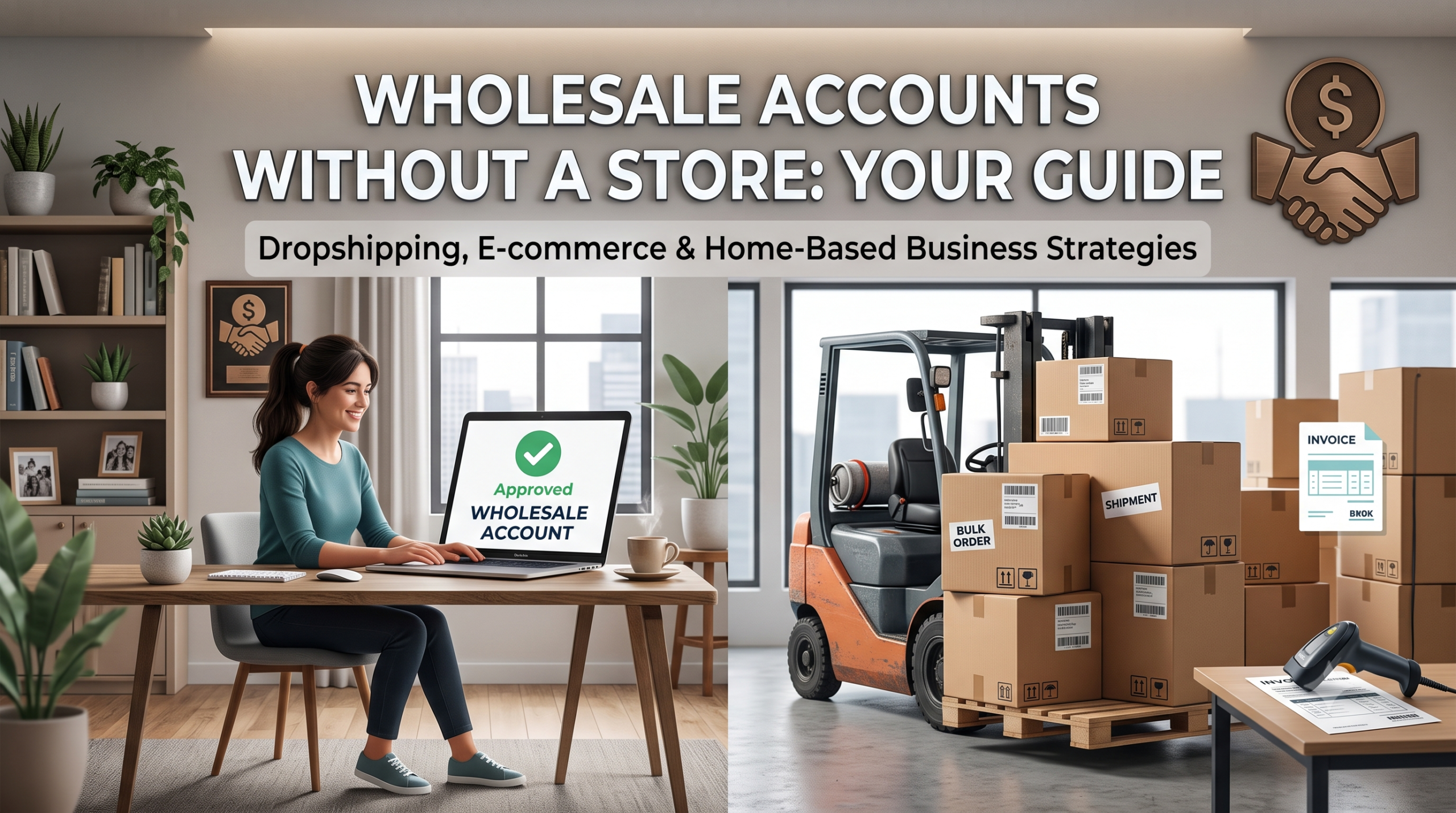
You do not need a shop with a front door to buy wholesale. Plenty of successful online sellers, market traders, and home based businesses get approved for real wholesale accounts every week, and not one of them owns a storefront. What they have instead is the paperwork and the presentation that make a supplier comfortable saying yes.
That is the whole game. A wholesale supplier is not checking whether you own a building. They are checking whether you are a real business that will reorder, pay on time, and not create problems. If you can prove that on paper, the lack of a physical store almost never matters. This guide walks through exactly how to do it, in plain steps, with examples.
Key Takeaways
- A physical store is almost never required. Suppliers want a legitimate, registered business, not a building.
- The three documents that open most doors are a business registration, an EIN, and a resale certificate.
- A professional online presence (a domain email, a simple website, and clear contact details) replaces the storefront as your proof of being real.
- Finding a supplier and getting approved by one are two separate steps. Apply prepared, not with questions.
- Start with suppliers who are used to online sellers. Distributor directories and marketplaces are friendlier than big brands for a first account.
- If one supplier says no, it is usually about minimums or fit, not about you personally. Move to the next.
- Why suppliers ask for a store, and what they really want
- The documents you actually need
- Building a business presence without a shop
- Finding suppliers who work with online sellers
- How to apply and get approved, step by step
- Common mistakes that get applications rejected
- What to do when a supplier says no
- Turning a first approval into repeat approvals
- A note on different countries and regions
- Frequently asked questions
Why Suppliers Ask for a Store, and What They Really Want
Years ago, wholesale meant selling to shops. So suppliers built their application forms around shops, and many still ask for a store name, a store address, or a photo of your premises. That history is the only reason the question exists. The internet changed who buys wholesale, but a lot of paperwork never caught up.
Here is what a supplier is really trying to find out when they ask about your store:
- Are you a real business? Not a bargain hunter trying to buy one unit at cost.
- Will you buy again? Wholesale runs on repeat orders, not one time purchases.
- Can you handle their minimums? Most set a minimum order, and they want buyers who can meet it.
- Will you protect their brand? They do not want their products dumped at strange prices or sold in ways that damage their name.
Notice that none of those four questions actually require a storefront. A home based Amazon seller doing steady volume answers every one of them better than a small shop that orders once and disappears. Once you understand what the supplier is worried about, you can answer the worry directly instead of panicking about the building you do not have.
Stop thinking “I do not have a store, so I might get rejected.” Start thinking “I am a real business, and here is the proof.” The paperwork below is that proof. Suppliers approve businesses, and a business is a legal and financial thing, not a physical one.
The Documents You Actually Need
This is the part that does the heavy lifting. Three documents handle most of it. Get these in order and you look exactly like the buyer suppliers want, store or no store.
A registered business
You need to be an official business, not just a person. In the United States that usually means forming an LLC or registering as a sole proprietorship. An LLC is the popular choice because it separates your personal money from your business money and looks more established on an application.
You can register a business from home. Your home address becomes your business address, and that is completely normal. Thousands of suppliers ship to home addresses every day. If you would rather not use your home address publicly, a cheap solution is a virtual business address or a PO box, though some suppliers prefer a street address, so keep that in mind.
If you have not formed your business yet and want to keep costs low, the state you register in changes the price. We broke that down in our guide to the cheapest state to form an LLC, which is worth a look before you file.
An EIN (your business tax number)
An EIN, or Employer Identification Number, is a free number the IRS gives your business. Think of it as a Social Security number for your company. Suppliers often ask for it to confirm you are a registered business, and having one means you do not have to hand out your personal Social Security number on every application.
It is free and takes a few minutes to get directly from the government. You can apply on the official IRS EIN page. Be careful with search results here, because many sites charge a fee for something the IRS gives away for nothing.
A resale certificate (the big one)
This is the document that matters most for wholesale, and the one new sellers understand least. A resale certificate (sometimes called a seller’s permit, a sales tax permit, or a resale license depending on your state) does two things. It lets you buy inventory without paying sales tax, since the tax gets collected later when your customer buys the item. And it proves to a supplier that you are a legitimate reseller, not an end consumer.
When a supplier asks you to “provide your resale certificate,” this is what they mean. Handing one over cleanly is often the single strongest signal that you belong in a wholesale account. You get it from your state’s tax authority, usually the Department of Revenue or Department of Taxation. Rules vary by state, and this plain overview of resale certificates is a good primer before you apply in your own state.
Maria sells kitchen gadgets from her spare room. She forms an LLC online for a small fee, gets a free EIN from the IRS the same afternoon, and applies for a resale certificate through her state’s tax website that week. She has no shop, no employees, and no warehouse. But when a cookware distributor asks for her paperwork, she sends all three documents in one email. To that supplier, Maria looks identical to a store owner. She gets approved.
The names change outside the United States, but the idea is the same. In the United Kingdom you register a business and use a VAT number. In Canada you use a business number and a resale or tax exemption certificate. Whatever your country, the supplier wants two things: proof the business is real, and proof you are buying to resell. Find your local equivalents of the three documents above.
Building a Business Presence Without a Shop
Paperwork gets you past the form. Presentation gets you past the human who reads it. Since you cannot point to a storefront, your online presence becomes the thing that says “real business.” The good news is that this is cheap and fast to set up.
Get an email on your own domain
This is the smallest change with the biggest effect. An email like [email protected] looks like a business. An email like [email protected] looks like a hobby. Suppliers notice this instantly. A domain costs a little each year, and business email plans are cheap. Do this before you apply anywhere.
Put up a simple website
You do not need a fancy online store to get approved. You need a clean, simple site that shows you are a working business. Even a single page with your business name, what you sell, a short about section, and a contact form does the job. If you sell on Amazon, eBay, Etsy, or your own store, link to it. A supplier who can click through and see you actually selling is a supplier ready to say yes.
Be reachable and consistent
Use the same business name, address, and phone number everywhere. A business phone number (even a cheap virtual one) beats a personal cell on an application. Consistency signals that you are organized and here to stay, which is exactly the impression you want.
The simple test
Before you apply anywhere, look at yourself the way a supplier will. Business email on your own domain? A page they can visit? A consistent name and number? If a stranger landed on your details, would they believe you run a real business? Get to yes on that question first, and approvals get much easier.
Finding Suppliers Who Work With Online Sellers
Not every supplier is a good first target. Some giant brands have strict rules and only deal with established retail chains. Chasing those first is how new sellers collect rejections and lose heart. The trick is to start with suppliers who already expect to work with online and home based businesses.
Here is where to look, from easiest to hardest for a first account:
- Wholesale directories. Directories list suppliers who want to be found by buyers like you, which already tells you they are open for business. You can browse suppliers by category and location in our wholesale supplier directory, which covers verified wholesalers across the USA, UK, and Canada.
- Distributors, not just brands. A distributor carries many brands and is usually more flexible on who they approve than the brand itself. Our guide to sourcing explains this gap between finding a distributor and getting approved by one, drawn from the wholesale sourcing articles on our blog.
- Niche wholesalers. Suppliers in a specific category often welcome smaller online sellers. If you sell knives, for example, our roundup of the best wholesale knife distributors in the USA shows the kind of specialist supplier that is realistic to approach early.
- Amazon and marketplace friendly suppliers. Some wholesalers are set up specifically for FBA and online sellers, with case packs and prep friendly shipping. If that is your model, start with our Amazon FBA supplier category.
James wants to sell pet supplies online. Instead of emailing a huge national pet brand that ignores him, he opens a directory, filters to pet suppliers, and finds a mid sized distributor that lists “online sellers welcome” on its profile. He applies there first. Because the distributor already works with sellers like him, his paperwork sails through, and he has his first wholesale account within a week. He can approach the big brands later, once he has order history to show.
How to Apply and Get Approved, Step by Step
Finding a supplier and getting approved by one are two different jobs. Most people only plan for the first. Here is the second, laid out in order. Follow it and you will apply the way an experienced buyer does.
“Hi, I run [Business Name], an online retailer selling . We are interested in opening a wholesale account with you. Our business registration, EIN, and resale certificate are attached. Could you share your wholesale pricing and minimum order? Thank you.” Simple, complete, and it answers the supplier’s main questions before they ask.
Common Mistakes That Get Applications Rejected
Most rejections are not about the missing store at all. They are about avoidable errors that make a seller look unprepared. Here are the ones to skip.
| The mistake | Why it hurts | Do this instead |
|---|---|---|
| Applying with a personal Gmail address | Looks like a hobby, not a business | Use an email on your own domain |
| Leaving form fields blank | Reads as careless or incomplete | Fill every field, even if you improvise the store field |
| Not having a resale certificate ready | Signals you may not be a real reseller | Get it before you apply, attach it up front |
| Asking lots of basic questions instead of applying | Makes you look new and high effort | Apply prepared; ask only what the terms do not answer |
| Chasing only huge brands first | They have the strictest rules | Start with directories and distributors |
| Ignoring the minimum order | Wastes the supplier’s time and yours | Confirm you can meet it before applying |
If you want a deeper look at the sourcing errors that trip up online sellers specifically, our related read on the mistakes sellers make about wholesale suppliers covers the trap of confusing a low price with a legitimate supplier, which is worth understanding before you buy from anyone.
What to Do When a Supplier Says No
You will hear no sometimes. Every experienced buyer has. The mistake is reading it as a verdict on you. Usually it is not.
A no often means one of these simple things: their minimum order is higher than you can commit to right now, they have exclusive sellers in your area, they only work with buyers in a certain channel, or they are simply not taking new accounts this quarter. None of that is personal, and none of it means the next supplier will say the same.
When you get a no, do three things. Ask politely if there is a minimum or a condition you could meet later, so you know whether to circle back. Note what they said, because a pattern across several suppliers tells you what to fix. Then move on to the next supplier without losing a day. Wholesale is a numbers game early on. The sellers who build strong supplier lists are simply the ones who kept applying after the first few noes.
The Practical Takeaway
You do not need a store. You need to look like a real business and apply like one. Register the business, get your EIN and resale certificate, set up a domain email and a simple site, then start with suppliers who already work with online sellers. Apply prepared, attach your paperwork up front, and treat every no as information, not rejection. Do that, and the lack of a storefront stops being a barrier and becomes a non issue.
Turning a First Approval Into Repeat Approvals
Getting one account is the hard part. Getting your fifth is easier, because approvals feed on each other. Once you have a supplier relationship and some order history, every future application gets stronger. Suppliers talk to buyers who look proven, and nothing looks more proven than an existing wholesale account you can point to.
So treat your first approval as an asset, not just a win. A few simple habits turn one yes into many.
Pay on time, every time
This sounds obvious, but it is the single biggest thing that separates buyers suppliers love from buyers they tolerate. Wholesale often runs on terms, meaning you pay within a set window after you receive goods. Hit that window without fail. A supplier who trusts your payment will raise your limits, offer better pricing, and vouch for you if another supplier ever asks. Late payment does the reverse, quietly, and you rarely get told why the perks stopped.
Order consistently, not just once
Wholesale is built on repeat business. A buyer who orders steadily, even in modest amounts, is worth more to a supplier than one who places a single large order and vanishes. Consistent reordering is what turns a cautious first approval into a supplier who treats you as a partner. It also gives you the order history that makes the next supplier say yes faster.
Communicate like a professional
Reply to emails. Give notice when your orders will grow. Flag problems early instead of going silent. Suppliers are people running businesses, and they remember the buyers who are easy to work with. That goodwill is worth real money over time, in the form of better terms, early access to stock, and flexibility when you need it.
After a year of paying on time and reordering monthly, Maria asks her cookware distributor for a reference to a second brand they carry. The distributor makes a quick introduction, and the new brand approves her almost immediately, because a supplier they trust just vouched for her. Maria never had a store. What she had was a track record, and a track record opens doors that no storefront ever could.
A Note on Different Countries and Regions
The core idea travels everywhere, but the paperwork has different names depending on where you are. If you sell outside the United States, or you are sourcing from suppliers abroad, here is the quick translation so you know what to ask for.
| Region | Prove the business is real | Prove you resell |
|---|---|---|
| United States | LLC or sole proprietor registration, plus an EIN | Resale certificate or seller’s permit from your state |
| United Kingdom | Registered company or sole trader, plus a VAT number if registered | VAT registration and business details |
| Canada | Business registration and a Business Number (BN) | Resale or tax exemption certificate, varies by province |
Whatever the labels, the supplier is asking the same two questions in every country: are you a real business, and are you buying to resell. Find the local documents that answer those two questions and you are set. If you are sourcing across borders, you can browse suppliers by country in our directory of wholesale distributors in the USA, the UK, and Canada, which is a fast way to find suppliers already set up for buyers in your market.
The best next step is a practical one. Open a directory, pick your category, and find three suppliers who look like a fit for a first account. You can start browsing verified wholesalers right now in the WholesaleSeeker directory, or if you are ready to be found by buyers yourself, you can list your own business and join the suppliers that online sellers reach out to every day.
Frequently Asked Questions
Can I really get a wholesale account without a physical store?
Yes. Most suppliers care that you are a registered, legitimate business that will reorder and meet their minimum, not that you own a building. Online sellers, market traders, and home based businesses open wholesale accounts constantly. Your business registration, EIN, and resale certificate matter far more than a storefront.
Do I need an LLC, or is a sole proprietorship enough?
Either can work, but an LLC is often the stronger choice. It separates your personal finances from your business and tends to look more established on an application. A sole proprietorship is cheaper and simpler to start. Many sellers begin as a sole proprietor and move to an LLC as they grow.
What is a resale certificate, and why do suppliers want it?
A resale certificate, also called a seller’s permit or sales tax permit, proves you are buying inventory to resell rather than to use yourself. It lets you buy without paying sales tax up front, and it tells a supplier you are a real reseller. It is usually the single most important document for getting a wholesale account.
Can I use my home address for a wholesale account?
Yes. Using your home address as your business address is normal and common. Suppliers ship to home based businesses every day. If you prefer not to use your home address publicly, a virtual business address or PO box is an inexpensive alternative, though some suppliers prefer a street address.
How long does it take to get approved?
It varies by supplier. With your documents ready, some approve within a day or two, while others take a week or more to review. Applying with complete paperwork and a clear introduction is the fastest way to move to the front of the line.
What if I do not have any sales history yet?
You can still get approved, especially with suppliers who work with newer online sellers. Focus on presenting a complete, professional application with all your documents. Once you build some order history, larger and stricter suppliers become easier to approach.
Are wholesale directories free to use?
Browsing a directory to find suppliers is typically free. WholesaleSeeker lets you search verified wholesalers by category and location at no cost, so you can build a list of realistic suppliers before you apply.
Ready to find your first supplier?
Browse verified wholesalers by category and location, no storefront required, and build your shortlist in minutes.



2 Comments
Pingback: VAT to Sell Wholesale on Amazon UK?
Pingback: Dropshipping Suppliers That Ship From USA (2-3 Day Delivery Guide 2026)