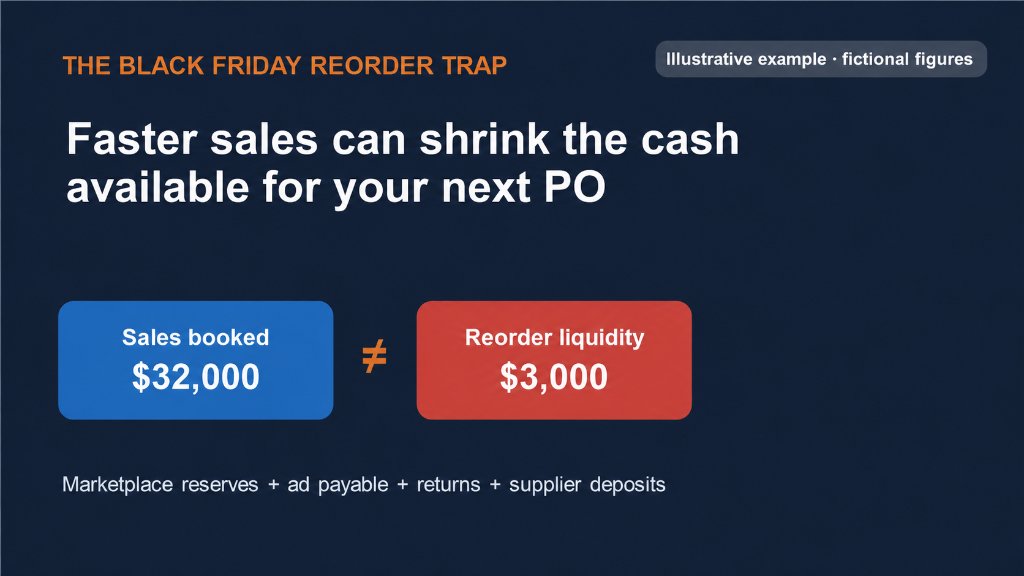
Black Friday can create a paradoxical operating result for wholesale and Amazon sellers: inventory moves rapidly, advertising efficiency reports show gains, and top-line revenue rises, yet the business finds itself with less usable cash to fund its next purchase order.
This challenge is fundamentally a timing mismatch across marketplace disbursement schedules, advertising accruals, customer returns, and supplier deposit deadlines. The practical question following a peak promotional sales spike is never simply, “How many units did we sell?” The true question is, “How much reorder liquidity will remain after promotional orders have fully settled?”
- Faster Sell-Through Is Not the Same as Replenishment Capacity
- Building a Reorder Liquidity Bridge
- A Worked Example: The Fictional $32,000 Sales Spike
- How Marketplace Account Reserves Shift Available Cash
- Advertising Accrual Creates a Secondary Timing Gap
- Factoring Expected Returns Before They Arrive
- Reordering the Signal, Not Just the Units Sold
- Integrating Production Lead Time and Freight Modes
- The Five-Question Release Rule for Every Purchase Order
- About the Author
Faster Sell-Through Is Not the Same as Replenishment Capacity
Selling 30 days of inventory in seven days does not mean the proceeds are immediately available to replace those units.
When an order spike occurs, the marketplace records the transaction. However, the platform often holds a significant share of those funds under an account-level reserve or a delivery-date-based reserve. Meanwhile, advertising costs continue to accumulate. Customer refunds and return handling charges surface well after the initial purchase event. The supplier, by contrast, frequently requires an upfront deposit before any of those post-sale deductions are settled.
Replenishment decisions become dangerous when an operator treats gross ordered revenue as spendable bank cash. Decision-making becomes defensible when the management team clearly separates three distinct numbers:
- Revenue booked during the promotion: The gross top-line figure displayed on dashboard reporting.
- Contribution expected after variable costs: Net margin remaining after referral fees, fulfillment charges, and direct ad spend. Before committing cash, verify unit economics with our free profit margin calculator.
- Cash expected to be in the bank before the supplier deposit date: The actual liquid capital available to clear the next invoice.
Only this third number can legitimately fund a production run.
Building a Reorder Liquidity Bridge
To avoid a capital crunch, begin with the cash available in your account today, rather than top-line numbers reported by the marketplace. Add only the settlement transfers scheduled to arrive before the supplier deposit deadline. Next, deduct all obligations that must be settled during that exact calendar window.
Reorder Liquidity = Available Cash + Settlements Due Before Deposit Date – Advertising Payable – Expected Refunds & Return Costs – Tax & Platform Fees – Minimum Operating Buffer
Subtract only the obligations that are not already accounted for within your current balance or expected disbursement; otherwise, you will double-count expenses. This calculation is a strict timing model, separate from a profit-and-loss statement. It demonstrates whether the business can release a purchase order without breaching its baseline safety buffer.
A Worked Example: The Fictional $32,000 Sales Spike
Consider a fictional seller that normally sells 1,000 units of a product each month. During Black Friday week, sales surge to 800 units at a discounted price of $40, generating $32,000 in gross ordered revenue.
Encouraged by rapid inventory turnover, the team considers reordering all 800 units right away. The manufacturer requires a 30 percent deposit on a $14,400 production run, equaling $4,320. At first glance, a $4,320 deposit appears trivial to cover from $32,000 in sales.
When viewed through a structured cash bridge, the picture shifts dramatically. In this scenario, the expected transfer amount does not yet reflect separate obligations due in the same period:
| Financial Component | Amount |
|---|---|
| Cash Currently Available in Bank | +$6,500 |
| Marketplace Settlement Due Before Deposit Date | +$9,200 |
| Advertising Invoices Payable in Period | -$4,800 |
| Expected Refunds, Return Processing, and Inbound Freight | -$1,600 |
| Other Marketplace Fees and Tax Liabilities Due | -$1,300 |
| Minimum Required Operating Cash Buffer | -$5,000 |
| Actual Reorder Liquidity Available | $3,000 |
The true reorder liquidity is $3,000 ($6,500 + $9,200 – $4,800 – $1,600 – $1,300 – $5,000). While the sales event is profitable on paper, the merchant cannot pay the $4,320 deposit without violating its operating safety floor.
This insight does not mean the seller must abandon replenishment altogether. Instead, it informs pragmatic adjustments: reducing initial order volume, negotiating a split production schedule, waiting for the subsequent disbursement, or restocking only core variants with proven year-round velocity.
How Marketplace Account Reserves Shift Available Cash
Marketplace reserve policies become critical during volume surges. A seller may see an impressive headline balance in their central dashboard, only to receive a fraction of that total on disbursement day.
Delivery-date reserves (common across Amazon Seller accounts) hold sales revenue until seven days after the latest estimated delivery date has passed. Unresolved customer claims, chargebacks, velocity limits, or rapid sales spikes can trigger additional holdbacks.
Avoid forecasting payout dates from memory. Inspect the live statement reports within your account dashboard. For every upcoming disbursement, document five metrics:
- The calendar window covered by the statement
- Gross sales revenue collected
- Marketplace commission and fulfillment deductions
- Total funds retained in reserve
- The confirmed bank transfer settlement date
If your replenishment plan fails when a payout experiences a five-day delay, the strategy is overly dependent on perfect execution.
Advertising Accrual Creates a Secondary Timing Gap
Advertising spend frequently accelerates before sales proceeds reach your bank account. During Q4 promotional peaks, daily budgets scale rapidly. Ad spend is billed directly to credit cards or deducted continuously, whereas attributed sales proceeds remain locked in delivery reserves.
A strong Return on Ad Spend (ROAS) does not eliminate this cash squeeze. For example, if ad spend expands from $300 to $800 daily and attributed revenue grows at an even faster clip, the campaign is commercially sound. However, if the ad invoice clears before marketplace cash lands in your account, your business is self-financing the float.
Always incorporate ad spend payable into your reorder bridge, capturing all accrued ad liabilities rather than only historical charges already subtracted from older statements.
Factoring Expected Returns Before They Arrive
Post-holiday shopping behavior differs significantly from standard baseline retail. Gift purchases, impulse buys, deep discounting, extended carrier transit times, and competitive price matching all push return rates upward.
Waiting until every return is processed before planning inventory is impractical, but ignoring return liability creates severe deficits. Model a conservative range by evaluating your historical return baseline alongside a stress-tested peak scenario. Apply this percentage to both lost margin and the unrecoverable expenses tied to returns, including reverse freight, inspection, repackaging, and unsellable write-offs.
A disciplined framework for validating demand before ordering wholesale inventory ensures your capital remains committed to profitable inventory rather than absorbed by customer returns.
Reordering the Signal, Not Just the Units Sold
Peak promotional sales consist of multiple demand components. Some units sell because the product enjoys genuine, durable market demand. Other sales are temporary artifacts of promotional pricing, coupon stacking, elevated PPC bidding, competitor stockouts, or artificial algorithmic ranking boosts.
Before reordering every unit that moved during peak week, segment sales into three categories:
- Durable demand: Baseline sales consistent with normal pricing, standard conversion rates, and sustainable ad spend.
- Promotion-dependent demand: Units that moved strictly due to deep discounting or aggressive, unprofitable advertising bids.
- Uncertain demand: Sales influenced by external market anomalies that your team cannot yet cleanly separate, such as brief competitor stockouts.
Reorder durable demand first. Apply conservative replenishment models to promotion-driven volume, and postpone reordering uncertain units until post-event conversion rates stabilize.
Integrating Production Lead Time and Freight Modes
Liquidity represents only one side of the replenishment equation. Purchase order volume must also balance factory production lead times against available logistics channels. When managing tight timelines, working with established prep and 3PL fulfillment centers allows merchants to streamline intake and carton inspection before inventory transfers into Amazon warehouses.
If a product risks stocking out before standard ocean freight arrives, evaluate splitting the shipment between a smaller air freight consignment and a larger ocean container. While air shipping increases per-unit landing costs, it provides fast inventory protection while reducing the risk of over-funding stock before demand normalizes.
Practical options to preserve liquidity include:
- Committing to a minimum factory production run immediately
- Staging production runs across dual supplier deposits
- Pairing an expedited air parcel shipment with secondary ocean freight
- Delaying the primary reorder until the next major settlement clears
- Excluding low-margin product variations whose sales depended entirely on heavy promotional discounts
Reviewing contractual terms and identifying potential supplier red flags before releasing initial deposits ensures production schedules are honored and inventory arrives on time.
The Five-Question Release Rule for Every Purchase Order
A structured release protocol prevents promotional euphoria from overriding sound cash management. Before approving a supplier deposit, require your merchandising team to answer five fundamental questions:
- What confirmed settlement cash will clear before each supplier milestone payment?
- What advertising, return processing, freight, and tax obligations take priority in that same period?
- What operating safety buffer remains intact after the deposit is paid?
- What portion of peak-week volume was created by temporary discounting or elevated advertising?
- Does the reorder model survive under a delayed settlement or higher return scenario?
If a purchase order depends on optimistic assumptions across all five checkpoints, it is not ready for sign-off. If it functions under your base case and remains viable under a conservative stress test, it represents an informed, defensible operating choice.
Preserving Post-Holiday Buying Power
The primary operational objective following Black Friday is preserving the working capital required to buy the right inventory at the right time.
Sales velocity is a helpful metric, but it remains incomplete until you reconcile account reserves, advertising liabilities, return provisions, supplier terms, and your operating cash floor. Performing that reconciliation converts a rapid sales spike into a controlled, profitable replenishment cycle instead of an unexpected cash trap.

Looking for Reliable Sourcing & Wholesale Suppliers?
Explore verified manufacturers, distributors, and logistics partners across North America and international hubs.